Third base has a way of exposing everything. Reaction time, arm strength, nerve, instincts, there is nowhere to hide. Manny Machado stepped into that spotlight in the majors at 20, and almost immediately looked as if he belonged there.
Over the years, he has become one of baseball’s most recognizable infielders: a right-handed hitter with middle-of-the-order power, a strong throwing arm, and a résumé that stretches from Baltimore to Los Angeles to San Diego. His career has also included tense on-field moments that shaped how people talk about him. The full picture is more interesting than either extreme. Machado has been a star, a lightning rod, and, for a long stretch, one of the sport’s most durable everyday players.
Miami roots and a fast track to pro ball
Manuel Arturo Machado was born on July 6, 1992, in Miami, Florida. He came up through the city’s deep baseball culture at Brito Miami Private School, part of the same South Florida pipeline that has produced major league talent for decades.
Baseball was the main path, but not the only sport in his life. He also played soccer when he was younger, later joking that he had “two left feet.” That mix of coordination and athleticism showed up in the way he moved on a baseball field: quick first step, soft hands, and the kind of body control that made difficult plays look routine.
Family has always been part of his story. He was raised by his mother, Rosa Núñez, and remained close to his grandfather Francisco Núñez and uncle Geovanny Brito. He also grew up around future big leaguer Albert Almora Jr., another Miami player with a similar baseball upbringing.
The Orioles selected Machado with the third overall pick in the 2010 MLB Draft. He did not go to college. Baltimore saw enough in his bat and glove to bet on him early, and the climb through the minors moved quickly.
Baltimore: arrival, defense, and early stardom
Machado made his MLB debut for the Baltimore Orioles on August 9, 2012. He was only 20, young for any infielder, especially one expected to handle a premium defensive role.
At first, the glove drew the loudest reviews. Machado’s work at third base was sharp, balanced and aggressive without looking rushed. In Baltimore, that naturally led to comparisons with Brooks Robinson, the franchise’s gold standard at the position. Comparisons are easy to overdo, but the praise reflected how polished Machado looked so early.
Then came the offensive leap.
In 2013, he led the American League with 51 doubles, made his first All-Star team, won his first Gold Glove, and also took home the AL Platinum Glove. It was the season that turned him from promising young infielder into one of the league’s central players. He was no longer just a defender with upside. He was producing in the middle of the lineup too.
Machado won a second Gold Glove in 2015 and returned to the All-Star Game in 2015, 2016 and 2018 while still with Baltimore. As his game matured, the shape of his career became clear: power to all fields, run production, steady durability, and defense that gave him value even when the bat cooled.
There were also incidents that followed him.
On June 7, 2014, he threw his helmet in the direction of Josh Donaldson after a tag play, prompting benches to clear. A day later, on June 8, he was ejected after throwing his bat toward the third-base area during a game against Oakland. On June 7, 2016, after being hit by a pitch, he charged Kansas City Royals pitcher Yordano Ventura, leading to ejections, a four-game suspension and a fine. In 2017, his slide into Dustin Pedroia sparked anger in Boston after Pedroia was injured on the play.
Those moments became part of the Manny Machado profile as much as the awards did. So did the debate around him. Some saw edge and competitiveness; others saw carelessness. Either way, he stayed at the center of the conversation because his talent was impossible to ignore.
Before leaving Baltimore, he reached another milestone: his 1,000th career hit came on August 9, 2018.
A brief, intense stop with the Dodgers
The 2018 season took a turn when Baltimore traded Machado to the Los Angeles Dodgers on July 18. It was a short stay, but a significant one.
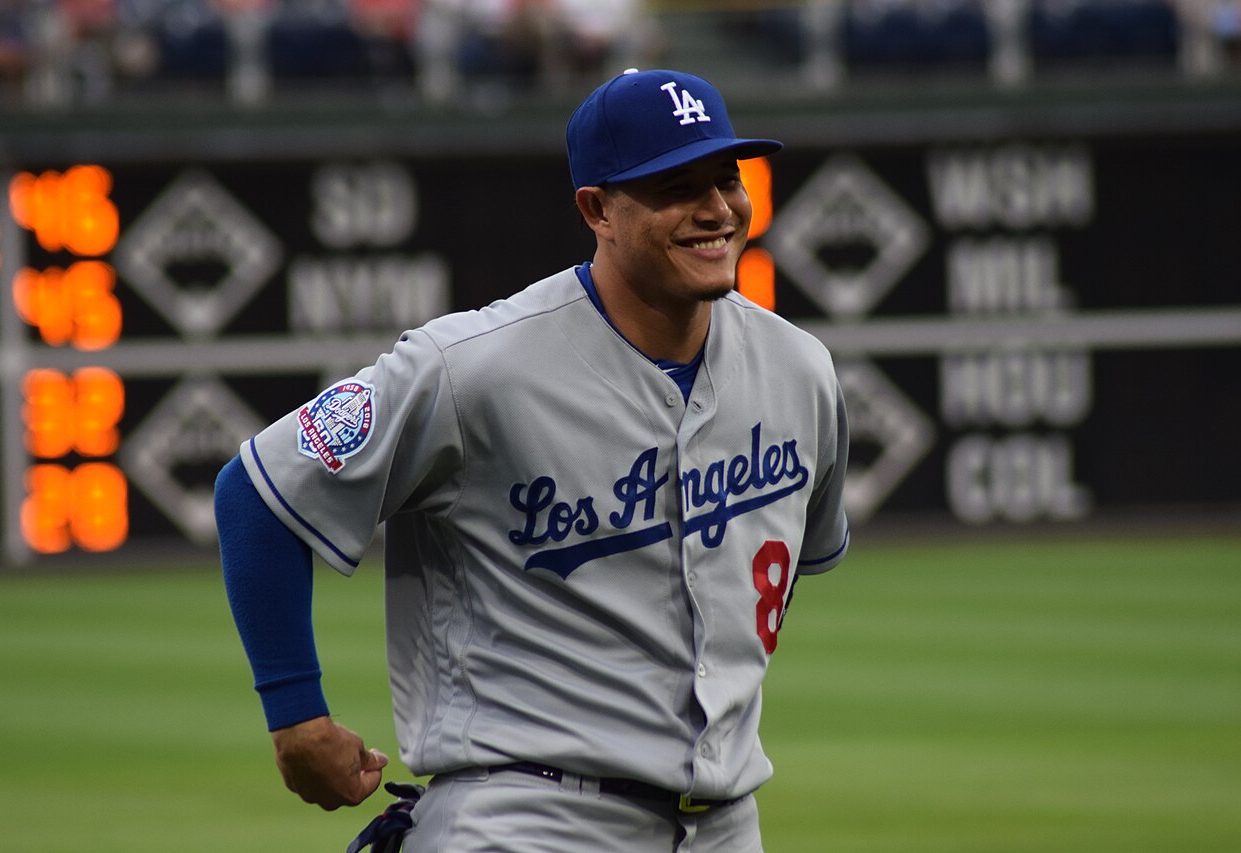
With the Dodgers, he shifted into a pennant-race spotlight and helped the club reach the World Series. He wore No. 8 in Los Angeles because his usual No. 13 was unavailable, and because of his well-known admiration for Kobe Bryant.
That fall also brought some of the most scrutinized moments of his career. During the NLCS, Machado drew criticism for saying he was not “Johnny Hustle” after a play in which he did not run hard. In the same postseason, he was criticized for slides into Milwaukee Brewers shortstop Orlando Arcia while trying to break up double plays. In NLCS Game 4, he was fined $10,000 after a first-base incident involving Jesús Aguilar that led to a benches-clearing confrontation.
The Dodgers reached the 2018 World Series but lost to the Boston Red Sox. Machado then entered free agency as one of the biggest names on the market.
San Diego’s statement signing
When Machado signed with the San Diego Padres in February 2019, it was more than a contract. It was a franchise declaration.
The deal was for 10 years and $300 million, at the time one of the largest contracts in baseball history. San Diego was signaling that it intended to compete for stars rather than wait for them to arrive.
Machado quickly became one of the faces of the club. His production in San Diego gave the Padres exactly what they were buying: lineup power, everyday reliability, and a veteran presence on a roster trying to move from promise to contention.
He earned All-MLB First Team honors in 2020 and 2022, and he finished second in National League MVP voting in 2022 after one of the best seasons of his career. He was selected to the All-Star team again in 2021 and 2022, adding to the honors he had collected in Baltimore.
Before the 2023 season got underway, Machado and the Padres agreed to a new 11-year, $350 million contract extension on February 26, 2023, replacing the opt-out path in his earlier deal and tying him to San Diego for the long term.
His place in franchise history kept growing. On August 15, 2023, he became the Padres’ all-time home run leader, passing Nate Colbert with his 164th home run for the club. That was a notable correction to the timeline often misstated elsewhere: the record fell in 2023, not later. In 2024, he reached 1,000 career RBIs, another marker of how long he has been a middle-of-the-order force.
By this stage of his career, Machado had piled up nearly 400 home runs and more than 2,100 hits, numbers that reflect both peak ability and unusual consistency over time.
What kind of player is Manny Machado?
The easiest place to start is defense.
At third base, Machado built his reputation on reaction speed, body control and arm strength. He can make the slow roller look simple and the line-drive backhand look planned. The two Gold Gloves and Platinum Glove support what the eye has long said: at his best, he has been one of the elite defenders at the position.
Offensively, he developed into much more than a power bat. Machado has regularly hit for average, driven in runs, and handled the responsibility that comes with batting in the heart of a lineup. His game is not built on one hot year. It is built on accumulation and quality over a long stretch.
He has also played shortstop at times, though third base remains the clearest expression of his value.
Internationally, Machado has represented the Dominican Republic, reflecting his family heritage. In the 2017 World Baseball Classic, he was named Pool C MVP.
Life away from the field
Off the field, Machado’s life has remained closely tied to baseball. He married Yainee Alonso in November 2014. She is the sister of former major leaguer Yonder Alonso, making baseball part of the extended family as well.
He has also moved into business and sports ownership. In 2023, San Diego FC announced Machado as part of the ownership group for the MLS expansion club. He has been linked to other investments too, though reports about his broader real estate and business portfolio vary by outlet and are not always fully detailed in public records.
Some claims about Manny Machado net worth circulate widely online, but those figures are estimates from third-party sites and should be treated as such, not as confirmed financial disclosures.
His public image in San Diego has included charitable work. Through Team Machado and the Sky’s the Limit Foundation, he has supported youth-focused efforts in Miami, San Diego and the Dominican Republic. The Padres later named him their Roberto Clemente Award nominee, recognition tied to community impact as much as on-field standing.
There are smaller details that round out the picture. He has spoken about his admiration for Kobe Bryant, named a dog Kobe, and carried that connection into his choice of No. 8 during his Dodgers stint. It fits the larger outline: a Miami athlete shaped by more than one sport, with a public style that has always been direct and unmistakable.
The shape of his career
Machado’s career has never been bland. The highlights are obvious: the draft pedigree, the early debut, the Gold Gloves, the All-Star selections, the long run of production, the massive contracts, the place he carved out in Padres history.
The friction is part of the record too. It would be incomplete to leave it out. But so would any version of his story that reduced him only to those incidents.
What remains, above all, is the body of work. Few infielders of his era have combined power, defense and durability the way Manny Machado has.
FAQ
How old is Manny Machado?
He was born on July 6, 1992.
What position does Manny Machado play?
He is primarily a third baseman, though he has also played shortstop.
What team does Manny Machado play for?
He plays for the San Diego Padres.
When did Manny Machado make his MLB debut?
He debuted with the Baltimore Orioles on August 9, 2012.
Is Manny Machado married?
Yes. He married Yainee Alonso in November 2014.
What is Manny Machado’s contract with the Padres?
He signed an 11-year, $350 million extension with San Diego on February 26, 2023.
Photo: Ian D'Andrea, CC BY-SA 2.0, via Wikimedia Commons