Forty home runs and 70 stolen bases had never lived in the same major league season until Ronald Acuña Jr. put them together in 2023. That year did not come out of nowhere. It was the loudest version of a player the Atlanta Braves had been building around since he was a teenager: explosive at the plate, dangerous on the bases, and capable of changing a game in a few pitches.
From La Guaira to pro ball
Ronald José Acuña Blanco Jr. was born on December 18, 1997, in La Guaira, Venezuela, into a family where baseball was less a hobby than a shared language. His father, Ronald Acuña Sr., played in the minors. His grandfather, Romualdo Blanco, was a minor league pitcher. The wider family tree reaches into pro baseball too, with relatives including Alcides Escobar, Edwin Escobar, Kelvim Escobar and Vicente Campos.
That background mattered. Acuña grew up around the routines of the sport, not just the glamour of it. The athletic gifts were obvious early, but so was the expectation that talent had to be sharpened. His younger brothers also followed the same path into professional baseball, including Luisangel Acuña, who rose through the minors and reached the majors.
He did not go through the draft or college baseball. Instead, he entered the game the way many top Venezuelan prospects do: through the international market. The Braves signed him in July 2014 for a $100,000 bonus, a modest figure for a player who would soon become one of the sport’s biggest young stars.
The fast climb through the Braves system
The first years in pro ball moved quickly. Acuña played in the Gulf Coast League and at Danville in 2015, then spent 2016 with Rome. He also played winter ball in Australia with the Melbourne Aces, another stop in a development path that was already speeding up.
Then came 2017, the season that changed his status from intriguing prospect to one of the most talked-about young players in baseball. He opened with High-A Florida, moved to Double-A Mississippi, and finished at Triple-A Gwinnett. Three levels, one year, and production everywhere.
By the end of that season, the awards piled up: Baseball America Minor League Player of the Year, USA Today Minor League Player of the Year, and Arizona Fall League MVP. Scouts loved the whole package. He was not simply a power bat or a runner with flair. He looked like a true five-tool outfielder, with bat speed, arm strength, range and game-changing acceleration.
A jolt in Atlanta
Acuña debuted for Atlanta on April 25, 2018, and it did not take long for the majors to feel small around him. He played 111 games, hit .293/.366/.552, launched 26 home runs, drove in 64 runs and stole 16 bases. The numbers were excellent. The energy was what people remembered.
In August, he homered in five straight games, becoming the youngest player in major league history to do that. For stretches, he looked like he was playing at a different tempo than everyone else. He could turn a routine single into pressure, a hanging fastball into a quick lead, and a quiet night into a highlight.
He finished the season with the National League Rookie of the Year Award, the first major individual honor of his career.
Stardom arrives early
His second full season pushed him from promising young star into the center of the Braves’ future. In 2019, Ronald Acuña Jr. hit .280 with 41 home runs, 101 RBIs, 127 runs scored and 37 stolen bases. He led the National League in runs and came close to a 40-40 season before settling for something only slightly less rare.
Early that season, on April 2, 2019, Atlanta signed him to an eight-year, $100 million contract. The deal also included club options for 2027 and 2028. It was a franchise-shaping move and, for the Braves, an early bet that this blend of power and speed would age well enough to build around.
The awards followed. He made his first All-Star team in 2019 and won his first Silver Slugger. In the shortened 2020 season, he added another Silver Slugger and won the Luis Aparicio Award, given to the top Venezuelan player in the majors.
Injury interrupts the rise
By 2021, he was again one of the sport’s most electric players, and again an All-Star. Then, on July 10, his season stopped. Chasing a fly ball in Miami, Acuña tore the ACL in his right knee. He had played only 82 games, but still hit .283 with 24 home runs, 52 RBIs and 17 steals.
Atlanta went on to win the World Series that fall, giving him a championship ring even though he could not be on the field for the postseason run. It was a strange line in his story: a title season, but one shaped as much by absence as by achievement.
The next year was more uneven. Returning from a major knee injury is rarely smooth, and 2022 showed that. He still made the All-Star team and still caused problems for pitchers and catchers, but the season felt more like a bridge back to full force than a final destination.
The season that made history
Some players have one year that captures everything they are. For Acuña, that was 2023.
Batting out of the leadoff spot, he hit .337/.416/.596 with 41 home runs, 106 RBIs, 149 runs, 217 hits and 73 stolen bases. He led the majors in runs, hits, on-base percentage and total bases, and he became the first player in major league history to produce a 40-homer, 70-steal season.
The achievement was not just statistical trivia. It showed how many ways he could control a game. He could start an inning with a walk, steal second, score on a single, and later leave the yard to the opposite field. He was a lineup starter and a lineup breaker at once.
The honors matched the season: National League MVP, NL Hank Aaron Award, All-MLB First Team, another All-Star selection and a third Silver Slugger. If there had been any lingering question about whether he was one of the defining players of his generation, 2023 answered it.
Another knee injury, then the road back
The next major turn in his career was painful and familiar. On May 26, 2024, Acuña tore the ACL in his left knee, ending his season after 49 games. A second ACL tear, this time in the opposite knee, brought another long rehab and another interruption just when he seemed to have reached his peak.
Because this profile is meant to stay factual and evergreen, it is best to stop short of unverified or time-sensitive claims about seasons beyond that point unless they are firmly documented in official records. What is clear is that injuries have become part of the full picture of his career, right alongside the awards and highlights. They have tested the durability of a game built on torque, burst and fearless movement.
What makes Ronald Acuña Jr. different
The easiest label is five-tool player, but that phrase can flatten a style that is actually pretty vivid. Acuña bats and throws right-handed. He has played all three outfield spots, though right field has been his main home. At his best, he combines elite bat speed with the willingness to attack early in counts, and he can drive the ball with authority to all fields.
The speed is not decorative. It changes defensive positioning, creates rushed throws and turns routine contact into extra bases. Even when he is not stealing, he is forcing attention. That pressure is part of his value.
There have also been stretches when effort and focus in the field drew criticism. That belongs in the record too, but as criticism, not scandal. Public commentary about his defense has surfaced at times, especially when his offensive brilliance raised expectations for every other part of his game. The broader truth is simpler: he is an impact player whose style can look breathtaking one inning and a little too loose the next.
Life away from the field
Off the field, family remains central to his public story. He is married to Maria Laborde, and the couple have children together. Acuña has often shared family moments publicly, and the baseball ties around him have always been part of how fans understand him.
He has also spoken through his public image and social media about interests beyond baseball: cars, fashion, music, basketball and video games. Reports and interviews over the years have painted him as someone who enjoys style and speed off the field almost as much as on it.
As for rumor, that line needs to stay clear. Speculation about future earnings or possible contract demands has circulated in media reports, but speculation is all it is unless it comes from a signed agreement or a direct, on-the-record statement. The documented fact is his 2019 contract with Atlanta, along with the club options attached to it.
Ronald Acuña Jr. in context
The shape of his career is already easy to see. He arrived young, became a star almost immediately, won big individual awards, played on a championship club, and produced one of the most unusual offensive seasons the sport has seen. He has also had to rebuild after serious injuries, more than once.
That mix is what makes his story interesting. Ronald Acuña Jr. is not just a collection of home runs, stolen bases and honors. He is a player whose best seasons feel fast even in retrospect, and whose career has swung between brilliance and interruption in ways that keep changing the story.
FAQ
How old is Ronald Acuña Jr.?
He was born on December 18, 1997.
What team does Ronald Acuña Jr. play for?
He has spent his entire MLB career with the Atlanta Braves.
Did Ronald Acuña Jr. win MVP?
Yes. He won the National League MVP Award for his 2023 season.
Did Ronald Acuña Jr. win a World Series?
Yes. He received a World Series ring when the Braves won the 2021 championship.
What is Ronald Acuña Jr.’s contract?
He signed an eight-year, $100 million contract with Atlanta on April 2, 2019. The deal includes club options for 2027 and 2028.
What is the 40-70 club?
It refers to a season with at least 40 home runs and 70 stolen bases. Ronald Acuña Jr. became the first player in MLB history to do it in 2023.
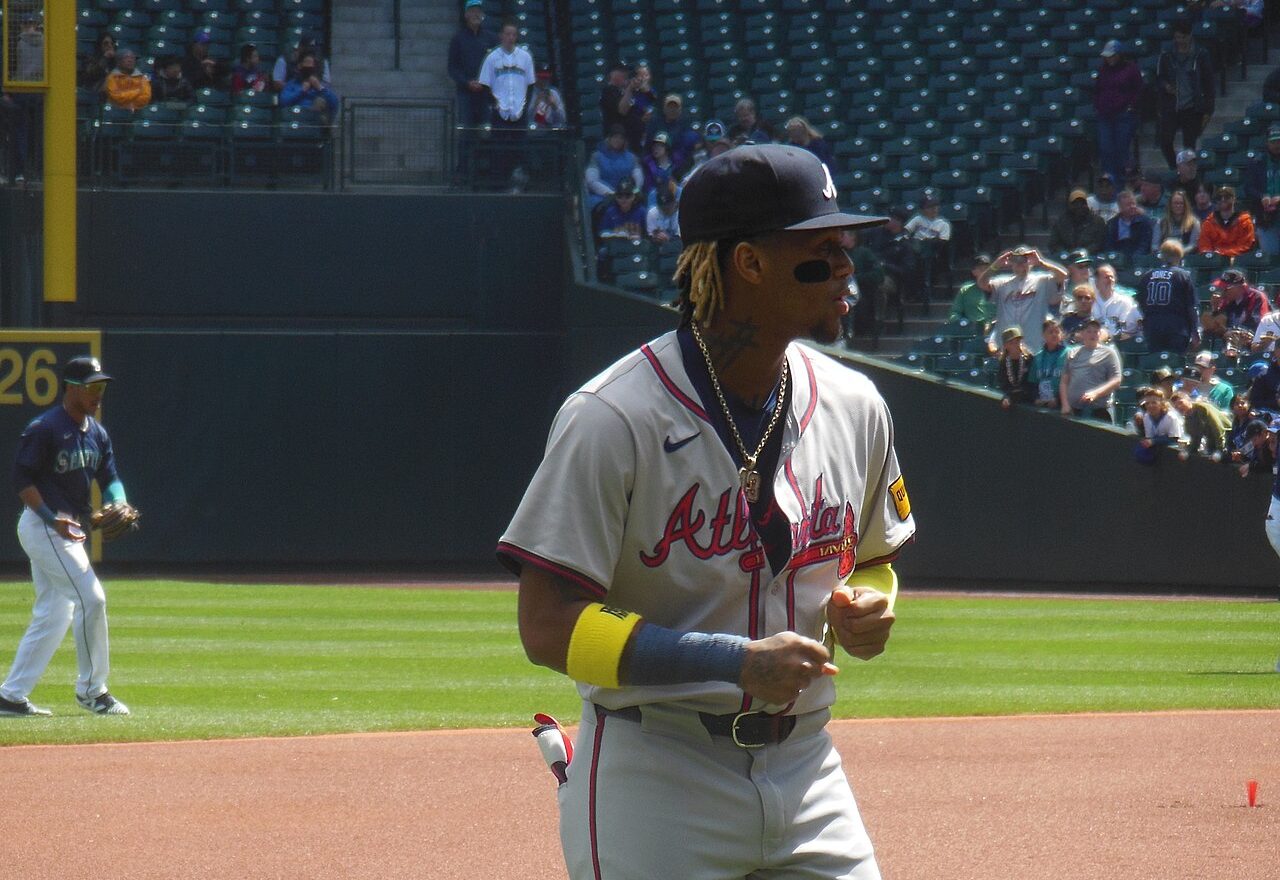
Photo: Jsayre64, CC BY-SA 4.0, via Wikimedia Commons