A sweet left-handed swing, a backward cap, and 630 home runs: that is the shorthand version of Ken Griffey Jr. The fuller story is better. Over 22 major-league seasons, Griffey became the rare player whose style never overshadowed his substance. He was a center fielder with power, range, and star presence, and he carried all three from his teenage debut in Seattle through later stops in Cincinnati and Chicago.
Growing up around the big leagues
George Kenneth Griffey Jr. was born on November 21, 1969, in Donora, Pennsylvania, the same small steel town that also produced Stan Musial. Baseball was woven into his life early. His father, Ken Griffey Sr., was an accomplished major leaguer, and Junior spent parts of his childhood around the Cincinnati Reds during the Big Red Machine years.
That upbringing gave him something most prospects never have: a close-up view of how the sport worked at its highest level. Clubhouses, travel, routines, pressure, none of it was abstract to him. By the time he was starring at Archbishop Moeller High School in Cincinnati, he was already one of the most closely watched amateur players in the country.
At Moeller, Griffey stood out as more than a polished baseball prospect. He was an elite athlete who also drew football scholarship interest as a wide receiver. In baseball, though, his path was clear. He was named the 1987 U.S. high school player of the year, and the Seattle Mariners made him the No. 1 overall pick in the 1987 MLB Draft.
His rise through the minors was quick. He played for Bellingham in 1987, then split time in 1988 between the San Bernardino Spirit and the Vermont Mariners. Seattle did not draft him to wait around.
Seattle and the making of “The Kid”
Griffey reached the majors in 1989 at age 19. From the start, he looked different, not just talented, but comfortable. He hit .264 with 16 home runs as a rookie and made the All-Star team the next season, the first of 13 straight selections from 1990 through 2000.
Seattle became the stage for his best years. In his first stint with the Mariners, from 1989 through 1999, Griffey hit .299 with 398 home runs, 1,152 RBI, and 167 stolen bases. He was not simply a slugger in center field. He was a true two-way star, covering ground in the outfield and making difficult catches look routine.
The awards piled up because the production did. Griffey won 10 straight Gold Gloves from 1990 through 1999. He also won seven Silver Slugger Awards, in 1991, 1993, 1994, and each season from 1996 through 1999. He led the American League in home runs four times: the strike-shortened 1994 season, then again in 1997, 1998, and 1999.
His peak came in 1997, when he hit .304 with 56 home runs and 147 RBI and won the AL MVP award. That season captured the full package: power, defense, durability, and the kind of easy athleticism that made him one of baseball’s defining stars.
There were memorable moments inside the numbers too. On September 14, 1990, Griffey and his father became the first father-son duo to hit back-to-back home runs in the same major-league game. Ken Griffey Sr. had joined Seattle late in the 1990 season, and the two played together from 1990 to 1991, not 1989, as is sometimes misstated.
By the end of the decade, Griffey was more than Seattle’s franchise player. He was one of the faces of the sport. He made the MLB All-Century Team in 1999, and his eight-game home run streak tied the major-league record at the time, matching Dale Long and Don Mattingly.
A blockbuster move to Cincinnati
One of the biggest turns in the Ken Griffey Jr. story came after the 1999 season. In February 2000, Seattle traded him to the Cincinnati Reds, the team he had grown up around as a child. Reports at the time tied his desire for a move in part to family considerations and proximity to his home in Florida, and Cincinnati was also a natural fit because of his roots in the city.
The Reds immediately committed to him with a nine-year, $116.5 million contract, one of the largest deals in the game at the time. The move was supposed to extend his prime in a familiar setting. Instead, it became a more complicated chapter.
Griffey still produced in Cincinnati, but injuries repeatedly interrupted him. From 2000 through 2008, he batted .270 with 210 home runs and 602 RBI in 945 games. Those are strong numbers on their own; they just look different next to the standard he had set in Seattle.
There were still standout moments. In 2005, after battling injuries, he won the National League Comeback Player of the Year award. In 2008, he reached another historic milestone when he hit his 600th career home run, becoming the sixth player in major-league history to get there.
His Reds years also explain part of why Ken Griffey Jr. stats can feel like two careers in one: the breathtaking Seattle peak, then the injury-shaped but still productive Cincinnati run. He wore No. 30 for most of that period and later No. 3.
Chicago, then one last return to Seattle
At the 2008 trade deadline, Cincinnati sent Griffey to the Chicago White Sox. It was a short stay, 41 regular-season games, and he hit .260 with three home runs and 18 RBI while wearing No. 17. The White Sox reached the postseason, though Griffey’s time there is remembered more as a brief late-career stop than a defining chapter.
He returned to the Mariners in 2009 for a final reunion with the franchise most closely tied to his name. The numbers were modest in that last stretch: over 2009 and 2010, he played 150 games and hit .214 with 19 home runs and 52 RBI. But the return mattered emotionally, both for Seattle and for Griffey himself.
He retired during the 2010 season, closing a career that had stretched across four different calendar decades.
The numbers that hold up
Even after the highlights and the signature swing, the statistical record is what keeps Griffey firmly among the game’s great center fielders.
His career totals:
– .284 batting average
– 630 home runs
– 1,836 RBI
– 2,781 hits
– 1,662 runs scored
– 184 stolen bases
– .370 on-base percentage
– .538 slugging percentage
– .907 OPS
– 83.8 Baseball-Reference WAR
Those numbers place him in unusually select company. His 630 home runs rank among the highest totals in major-league history, and unlike many sluggers, he paired that power with premium defense at a demanding position.
That is the key to his place in baseball history. Griffey was not just a home run hitter with flair. He was a complete center fielder at his best, and for a long stretch he was the standard at the position.
Hall of Fame status and lasting image
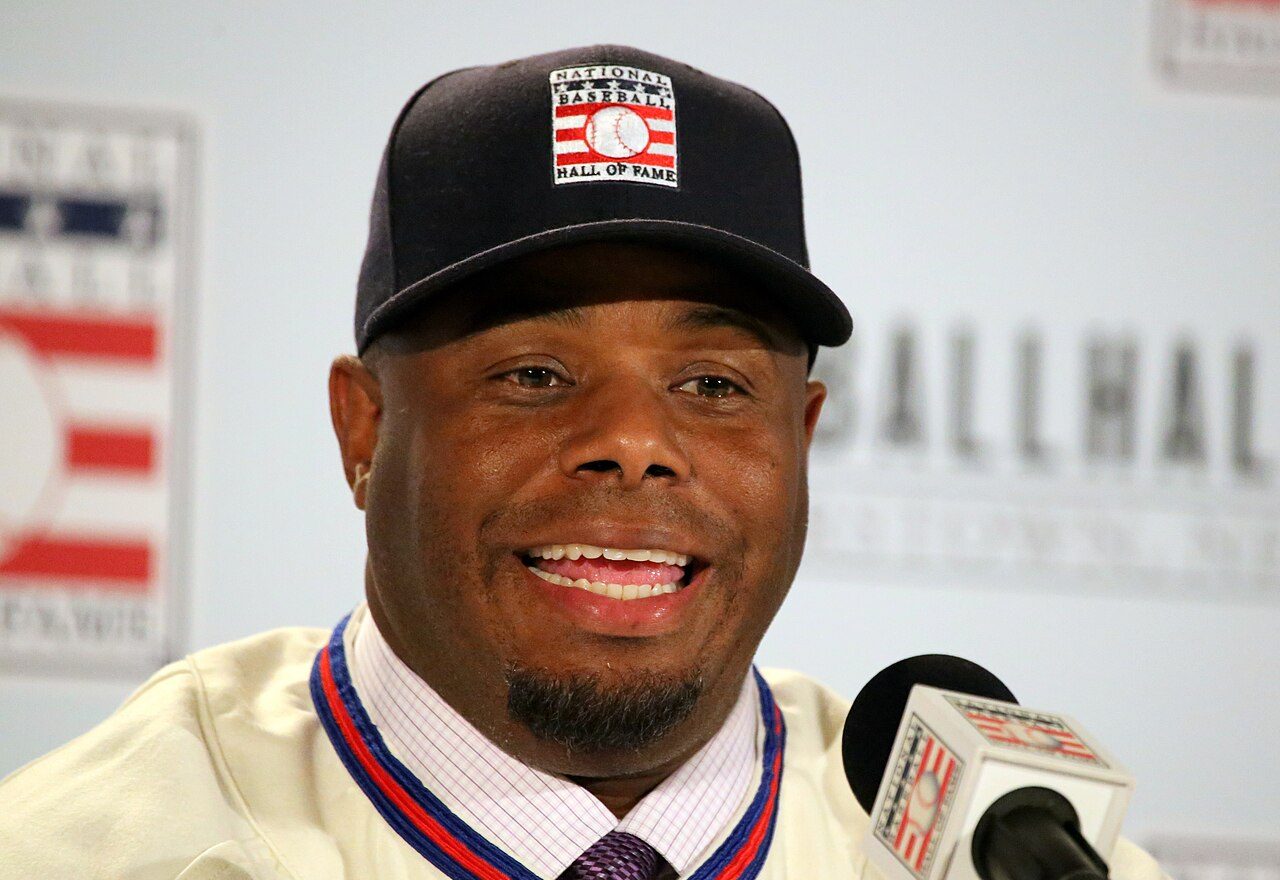
When Hall of Fame voting arrived, the result reflected how clearly his career had landed with writers and fans alike. Griffey was elected to Cooperstown in 2016 with 99.32 percent of the vote, the highest voting percentage ever at the time.
That same year, the Mariners retired his No. 24, the first number the franchise had ever retired. He also entered the Hall of Fame wearing a Mariners cap, a fitting choice for the club where his legend was built.
If the numbers explain the case, the visual memory explains the hold he still has on baseball culture. Griffey’s swing remains one of the most admired in the sport. His defense in center field looked loose, instinctive, almost playful. The nicknames, Junior, The Kid, fit because they matched the way he moved through the game.
He was also a major commercial figure in his prime, with endorsements that included Nike, Nintendo, Pepsi, Upper Deck, Rawlings, and American Express. The Air Griffey line helped make him one of the few baseball players whose appeal crossed cleanly into sneaker and pop culture.
Off the field: family, photography, and life after playing
Off the field, family has always been central to Griffey’s public story. He is married to Melissa Griffey, and they have children, including Trey Griffey, who played college football. Because private life should be handled carefully, it is best to stay with what Griffey and widely documented public sources have confirmed rather than drift into rumor.
His post-playing life has been active without being loud. Since 2011, he has served as a special consultant with the Mariners organization. He has also developed a serious second career as a sports photographer, working major events including golf tournaments, football games, auto racing, and baseball. It is an interesting turn for a former superstar: still around elite competition, but now watching through a lens instead of from center field.
Griffey has also been involved in charitable work through the Ken Griffey Jr. Family Foundation. Reports and public materials have linked him as well to business interests in Florida, including real estate, though those details tend to be less central than the baseball life he built in public view.
What lasts most is the shape of the career itself. Ken Griffey Jr. arrived young, became a star quickly, carried a franchise, changed teams in a headline move, fought through injuries, and still finished with numbers that place him among the most accomplished outfielders the game has seen.
FAQ
What teams did Ken Griffey Jr. play for?
He played for the Seattle Mariners, Cincinnati Reds, and Chicago White Sox.
How many home runs did Ken Griffey Jr. hit?
Ken Griffey Jr. hit 630 home runs in his major-league career.
When was Ken Griffey Jr. inducted into the Hall of Fame?
He was inducted into the National Baseball Hall of Fame in 2016.
Did Ken Griffey Jr. play with his father?
Yes. He and Ken Griffey Sr. were teammates on the Mariners from 1990 to 1991.
What position did Ken Griffey Jr. play?
He was primarily a center fielder.
Why is Ken Griffey Jr. so highly regarded defensively?
He won 10 straight Gold Glove Awards in center field from 1990 through 1999 and combined range, instincts, and highlight-reel catches.
Photo: Arturo Pardavila III on Flickr, CC BY 2.0, via Wikimedia Commons