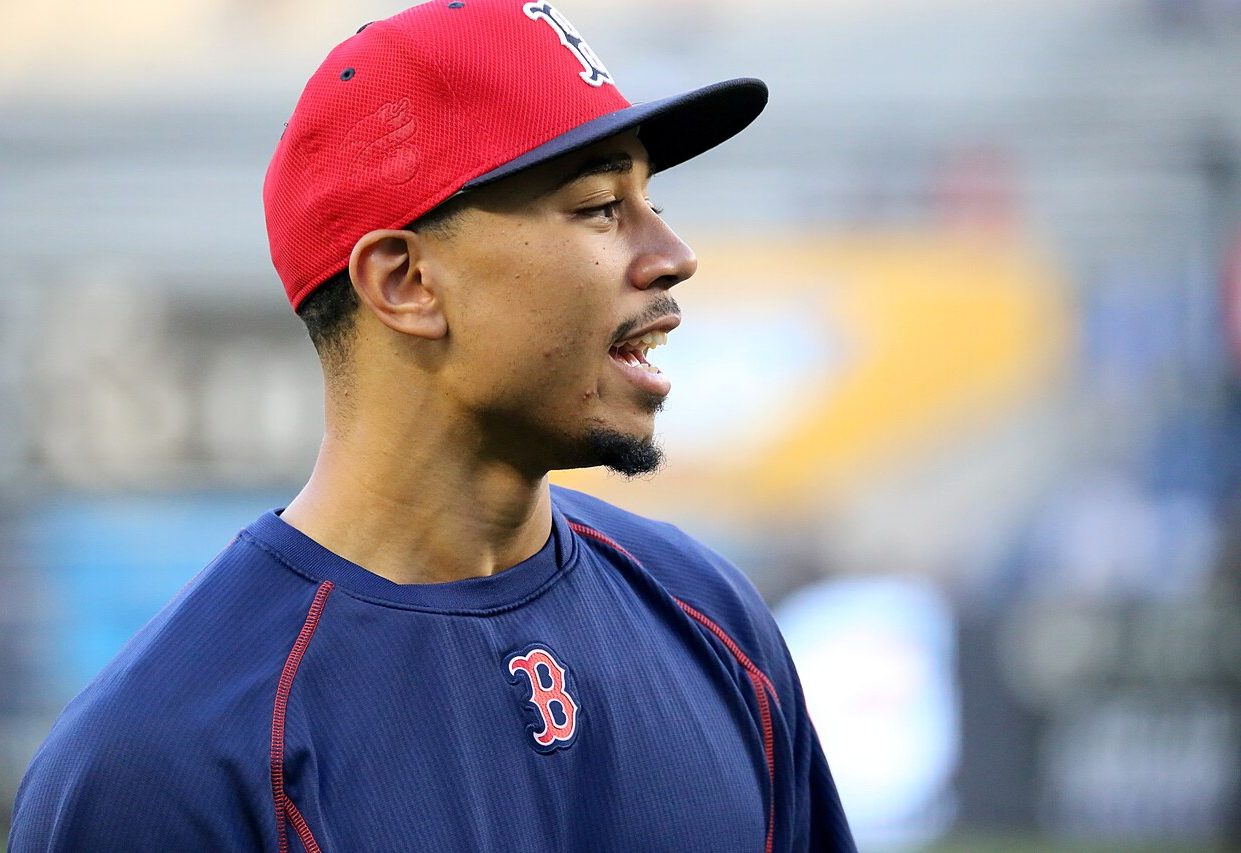
At 5-foot-9, Mookie Betts never looked like the prototype scouts used to sketch on clipboards. He just kept playing like one of the best players on the field anyway.
From Nashville gyms and bowling lanes to pro ball
Born Markus Lynn Betts on October 7, 1992, in Nashville, Tennessee, Betts grew up in a family where sports were part of daily life. His parents, Diana Collins and Willie Betts, gave him initials that spelled MLB, a detail that has followed him ever since. The nickname “Mookie” came from former NBA guard Mookie Blaylock, another small but dynamic athlete.
Baseball was close to home in more ways than one. Betts’ uncle, Terry Shumpert, played in the majors, so the path did not feel imaginary. It felt possible. His mother also played a direct role in keeping that path open. According to widely repeated accounts, she started a Little League team after other coaches passed on him because of his size. Whether told as family lore or origin story, it fits the player Betts became: skilled, stubborn, polished.
At John Overton High School in Nashville, he was far more than a baseball prospect. He starred in basketball and was named MVP of the District 12-AAA league during his senior year. He also excelled in bowling, winning Tennessee Boys Bowler of the Year honors in 2010. That was not a side note. Years later, he rolled a perfect 300 game at the 2017 World Series of Bowling, a reminder that his hand-eye coordination has always shown up in more than one arena.
Betts graduated in 2011 and committed to the University of Tennessee on a baseball scholarship. He never made it to campus. The Boston Red Sox selected him in the fifth round of the 2011 MLB Draft, 172nd overall, and he chose professional baseball instead.
Climbing the Red Sox system
His rise through Boston’s farm system moved quickly, but not in a straight, spotlight-heavy way at first. Betts began in the Gulf Coast League in 2011, then played for Lowell in 2012. In 2013, he split time between Greenville and Salem, and by 2014 he had reached both Portland and Pawtucket.
That 2013 season changed the conversation around him. He hit his way into prospect status and was named Boston’s minor league Offensive Player of the Year and Breakout Player of the Year. He was no longer just an undersized athlete with quick hands and speed. He was becoming one of the organization’s most complete young players.
By the time he reached the majors, the outline of his game was already clear: right-handed bat, sharp strike-zone judgment, line-drive contact, sneaky power, speed on the bases, and defensive value that gave a manager options.
Boston: debut, stardom and the 2018 peak
Betts made his MLB debut with the Red Sox in 2014, and over the next few seasons he turned into one of the American League’s most reliable all-around players. He was not built around one loud tool. He did a little of everything, and he did most of it well.
His first full seasons in Boston established that profile. He could hit for average, work counts without drifting into passivity, steal bases efficiently and defend at a high level in the outfield. In 2016, he became the first player in the majors to reach 200 hits that season, finishing with 214. It was a fitting milestone for a player whose game was rooted in constant pressure rather than occasional bursts.
Then came 2018, the season that still anchors any Mookie Betts biography. He hit .346 with 32 home runs, 80 RBI and 30 stolen bases, won the American League MVP award, took home a Gold Glove and a Silver Slugger, and helped lead Boston to a World Series title. The Red Sox won 108 games in the regular season, and Betts sat at the center of it.
That year did not make him a star from scratch. It confirmed what he had already become. He was one of the rare players who could shape a game in every phase: at the plate, in the field, on the bases, and in the way his consistency raised the floor of a lineup every night.
Betts remained with Boston through 2019. By the time that chapter closed, he had gone from useful young regular to franchise cornerstone.
Trade to Los Angeles and a bigger stage
In February 2020, the Red Sox traded Betts and David Price to the Los Angeles Dodgers. It was one of the defining moves of that offseason and one of the biggest talent swings in recent baseball history.
The Dodgers did not wait long to commit. On July 22, 2020, Betts signed a 12-year, $365 million extension that runs through the 2032 season. The deal included a $65 million signing bonus and significant deferred money. It was a franchise-level investment in a player whose value went beyond batting average or home run totals.
His first season in Los Angeles ended with a championship. Betts helped the Dodgers win the 2020 World Series, giving him titles in both leagues and with two different clubs. The fit was obvious from the start. On a roster already loaded with stars, he brought athleticism, edge and versatility.
The Dodgers years: versatility as a weapon
The Los Angeles stretch has added another dimension to his career. Betts did not simply continue as a standout right fielder. He expanded his defensive role, spending time in the outfield, at second base and at shortstop. For a player already carrying offensive value, that flexibility made him even more important.
In 2022, he hit .269 with 35 home runs and 82 RBI in 142 games. A year later, he was even better offensively, batting .307 with 39 home runs and 107 RBI, both career highs. He finished second in National League MVP voting in 2023 behind Ronald Acuña Jr. The regular season was excellent; the postseason was not. In the National League Division Series against Arizona, Betts went 0-for-11, a sharp reminder of how October can flatten even elite hitters into a few bad days.
The broader Dodgers run has been decorated with team success, but some of the claims in the original draft needed a factual reset. Betts has won the World Series with Boston in 2018 and with Los Angeles in 2020. Any additional championships beyond those two should not be stated as fact without confirmed results. The same caution applies to award totals and season-end records that were listed for later seasons.
Because several statistics in the source text were tied to future-dated checkpoints and could not be verified reliably, they are better left out than repeated as settled fact. What is clear, and fully established, is the shape of his Dodgers tenure: middle-of-the-order production, premium athleticism, and unusual defensive adaptability for a player of his stature and résumé.
What makes Mookie Betts different
Some stars are easy to summarize because one skill defines them. Betts has never fit that mold. He is a right-handed hitter with bat control, power that plays above his size, strong plate discipline and enough speed to affect games without forcing the issue. Defensively, he built his reputation in right field, where his reads, routes and arm strength made him one of the best at the position. His later work in the infield only added to the picture.
That is why advanced metrics have always liked him. Players who contribute in so many categories do not need one thing to be perfect every year. If the batting average dips, the defense still matters. If the home run total shifts, the on-base skill and baserunning still travel. He gives a club more than one way to win.
Life away from the field
Off the field, Betts has maintained a public image that feels broader than the standard superstar template. He is married to Brianna Hammonds, and the couple have children together. He has also been open about his love of bowling, which is not a novelty item in his story but a real second sport.
In business, Betts has built a substantial endorsement portfolio that has included brands such as Axe Bat, Baden Sports, BODYARMOR, Jordan Brand, Nike and Franklin Sports. He and his wife also invested in Turning Natural, a juice bar business, according to published reports.
Some details about his private life require careful wording. Reports have linked Betts to a home in Encino, Los Angeles, and celebrity net worth estimates have circulated publicly, but those figures and property details come from third-party reporting rather than direct confirmation from Betts. They should be treated that way.
The same goes for retirement talk. If Betts has discussed a possible endpoint to his career in interviews, that is one thing. But a firm retirement year should not be presented as settled unless he has clearly stated it on the record. For now, the safer and more accurate point is that his Dodgers contract runs through the 2032 season, with deferred payments extending beyond that.
His off-field résumé also includes recognized community work. Betts won the Roberto Clemente Award, one of baseball’s most respected honors for service and character, adding another layer to a public profile already shaped by family, business interests and a long-running connection to bowling.
The arc of his career
The easiest way to understand Mookie Betts is to start with the things that once seemed to work against him. He was smaller than the classic star outfielder. He did not arrive with the loudest prospect hype. He built his game through skill, precision and range rather than physical intimidation.
That is exactly why his career has held up so well as a story. From Nashville to Boston to Los Angeles, he has kept adding responsibilities without losing the sharpness that made him stand out in the first place. MVP winner. World Series champion. Gold Glove defender. Leadoff threat, run producer, outfielder, infielder, bowler. Few players have packed that much variety into one career without it ever feeling scattered.
FAQ
What is Mookie Betts’ real name?
His full name is Markus Lynn Betts.
What teams has Mookie Betts played for?
He has played for the Boston Red Sox and the Los Angeles Dodgers.
How many World Series titles has Mookie Betts won?
He has won two confirmed World Series titles as a player: with the Red Sox in 2018 and the Dodgers in 2020.
What positions does Mookie Betts play?
He has played right field, second base and shortstop in the majors.
Is Mookie Betts really a strong bowler?
Yes. He was Tennessee Boys Bowler of the Year in high school and later bowled a perfect 300 game at the 2017 World Series of Bowling.
What is Mookie Betts’ contract with the Dodgers?
He signed a 12-year, $365 million extension with Los Angeles in July 2020. The deal runs through the 2032 season and includes deferred money.
Photo: Arturo Pardavila III from Hoboken, NJ, USA, CC BY 2.0, via Wikimedia Commons