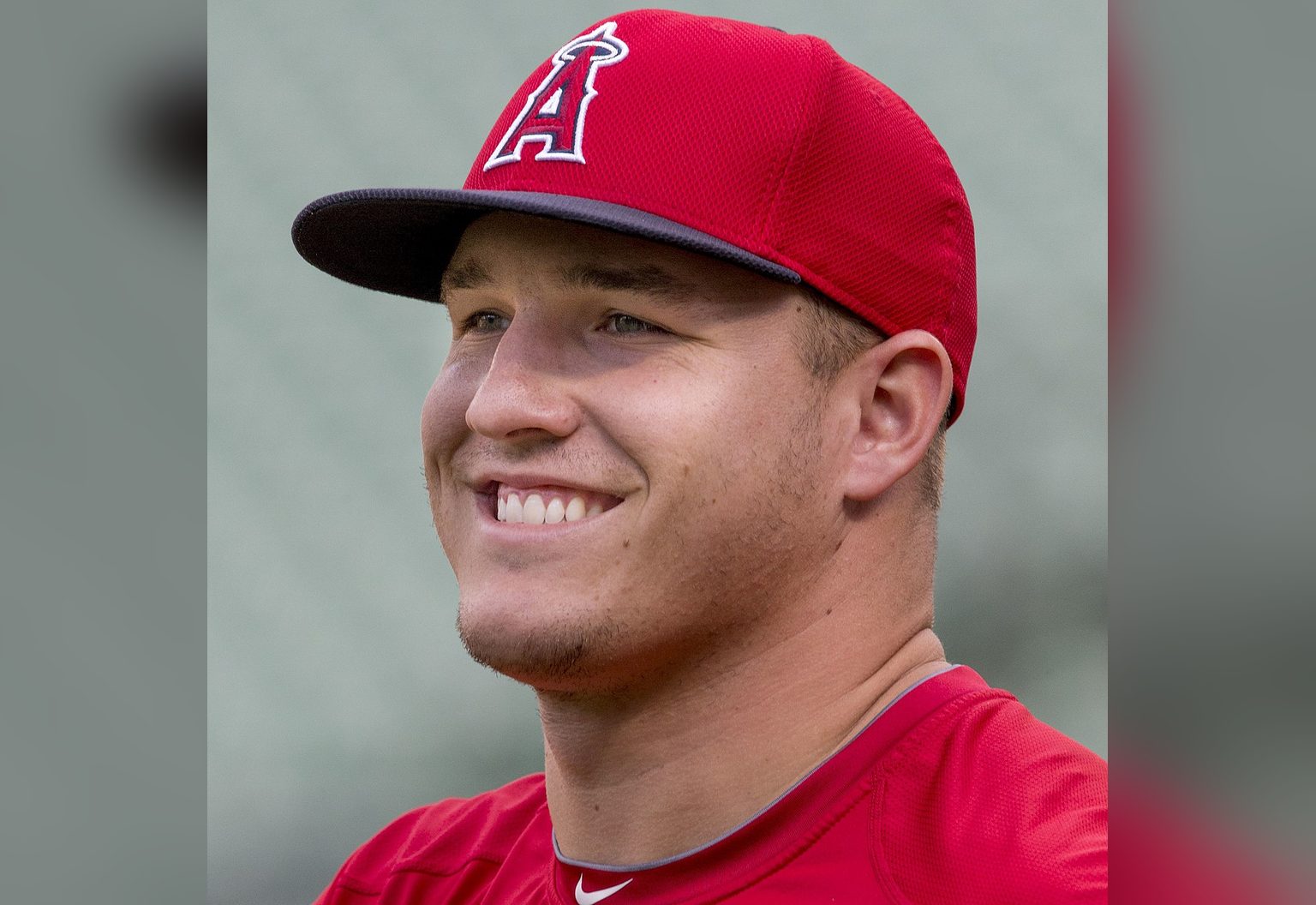
Three MVP awards, a Rookie of the Year trophy, and a long run as the standard against which other stars were measured, that is the broad outline of Mike Trout’s career. The details are even more impressive: a South Jersey kid who sped through the minors, reached the majors as a teenager, and for years made the difficult parts of baseball look routine.
Mike Trout’s roots in South Jersey
Michael Nelson Trout was born on August 7, 1991, in Vineland, New Jersey, and grew up in nearby Millville. Baseball was part of family life early. His father, Jeff Trout, played in the Minnesota Twins’ minor league system, and that gave the game a permanent place in the house. So did another influence closer to home: Mike Trout grew up a devoted Philadelphia Phillies fan.
As a young player, he wore No. 2 because of Derek Jeter. Later, at Millville Senior High School, he switched to No. 1 and became the kind of local talent scouts had to track closely. By the time he graduated in 2009, he was no longer just a standout in South Jersey. He was one of the most intriguing prep players in the country.
His senior season put that into numbers. Trout hit 18 home runs, a New Jersey high school record at the time, and paired that power with speed, arm strength, and unusual polish for a teenager. He had committed to East Carolina University, but pro ball came first. In the 2009 MLB Draft, the Los Angeles Angels selected him 25th overall in the first round, and he signed.
A fast climb through the minors
The first stop was rookie ball with the Arizona Angels in 2009, and it did not take long for Trout to separate himself. In 2010, he played across two levels and hit .341 with 10 home runs, 56 RBIs, and 56 stolen bases in 125 games. That season brought one of the earliest major honors of his career: Baseball America named him its Minor League Player of the Year.
That distinction matters here because the original version of this story credited him with the J.G. Taylor Spink Award, which is not correct. The Spink Award is a writers’ honor presented by the Hall of Fame, not a minor league player award. Trout’s actual minor league recognition in that period came from outlets and organizations that track prospects and player development.
Even before he reached Anaheim, the shape of his game was obvious. He could hit for average, draw walks, run, defend, and drive the ball with authority. The five-tool label gets tossed around too easily in baseball, but in his case it fit.
Mike Trout arrives in the majors
Trout made his MLB debut with the Angels on July 8, 2011. His first look at the majors was brief and uneven, which is often how these things go. In 40 games that season, he hit .220 with five home runs, 16 RBIs, and four stolen bases.
Then came 2012, the season that changed everything.
Recalled in late April, Trout turned into the most dynamic player in the American League almost immediately. He hit .326 with 30 home runs, 83 RBIs, 49 stolen bases, a .399 on-base percentage, and a .963 OPS in 139 games. He led the AL in runs scored with 129 and in stolen bases with 49, won the AL Rookie of the Year Award, and finished second in MVP voting.
One factual fix is needed here too: he was not the youngest player ever to win Rookie of the Year. He was 20 during that season, but several younger players had won the award before him. The point stands without the exaggeration, it was one of the best rookie seasons the sport has seen.
From phenom to the Angels’ franchise player
By the middle of the decade, Trout was no longer simply a rising star. He had become the player most often used as a benchmark. From 2012 through 2016, he finished either first or second in AL MVP voting every year.
His first MVP award came in 2014, when he hit .287 with 36 home runs, 111 RBIs, and a league-leading 115 runs scored. He also won the AL Hank Aaron Award that season, and the Angels reached the postseason. Their October stay was short, Kansas City swept them in the Division Series, and Trout still has not appeared in a World Series.
Another MVP followed in 2016. Trout batted .315 with 29 home runs, 100 RBIs, 30 stolen bases, and a 1.000 OPS, again showing how complete his game could be. His third MVP came in 2019, when he hit .291 with 45 home runs and a major league-best .438 on-base percentage despite playing 134 games.
Those seasons helped define his place in the sport, but the consistency around them may be just as important. Trout was selected to 11 consecutive All-Star Games from 2012 through 2023, excluding the canceled 2020 game and his injury-shortened 2021 absence from actual play despite selection status in some summaries. The original draft also listed a 2026 All-Star selection, which cannot be treated as established fact in a timeless profile and has been removed.
His Silver Slugger total also needed correction. Trout has won nine Silver Slugger Awards: 2012 through 2016, then 2018 through 2020. He did not win one in 2022.
Injuries, adjustments, and later chapters
For all the brilliance, Trout’s career has also included stretches shaped by injuries. A torn thumb ligament cost him significant time in 2017. A calf strain limited him in 2021. Back issues affected him in 2022. In 2023, a fractured hamate bone in his left hand interrupted another strong season.
That part of the story matters because it changed the rhythm of his career. The early version of Trout seemed to do everything at once: hit for average, hit for power, steal bases, patrol center field, and stay in the lineup nearly every day. Later seasons asked for adaptation. The speed remained useful, but less central. The power stayed. So did the patience. Even when he was not playing 150 games, pitchers still had to work around him.
Because the source text included future-dated statistics and claims through 2026, those numbers have been removed. A sports profile should not present unverifiable future totals as fact. What can be said with confidence is that Trout has already built one of the strongest resumes of his era, and he has climbed to or near the top of multiple Angels franchise leaderboards, including home runs and walks.
Contract, endorsements, and business interests
In March 2019, the Angels signed Trout to a 12-year, $426.5 million contract extension, one of the largest deals in North American sports at the time. It cemented his place as the face of the franchise and tied his prime years to one club.
Off the field, he has never been the loudest celebrity in baseball, but he has been one of its most marketable players. Trout has had endorsement deals with Nike, Rawlings, Topps, and BODYARMOR, among others. One of the more notable business details came when Coca-Cola acquired BODYARMOR in 2021; Trout reportedly held an equity stake, which several outlets said led to a significant payout.
Nike also made him a rarity in baseball marketing. In 2014, Trout became the first baseball player since Ken Griffey Jr. to receive a signature cleat line from the company.
What makes Mike Trout different as a player
At his best, Mike Trout has been the clearest modern example of a five-tool star. He can punish mistakes, take walks, cover the strike zone, run the bases intelligently, and handle center field. Advanced metrics loved him for years, but traditional numbers told the story too: home runs, runs scored, RBIs, stolen bases, and extra-base damage in every direction.
He was especially dangerous because there was no easy plan against him. Pitchers could not simply challenge him in the zone, and they could not count on chasing him out of it. He did damage on pitches down in the zone, handled velocity, and rarely looked rushed.
The nicknames followed naturally. “The Millville Meteor” tied him to his hometown and his quick rise. “Kiiiiid,” a nod to his youthful energy, stuck because he arrived in the majors looking both young and completely unfazed.
Off the field: private, local, and still tied to home
For a player with national fame, Trout has kept his private life relatively private. He is married to Jessica Cox, now Jessica Trout, and the couple have a son. Beyond that, publicly confirmed details have remained limited, which fits the way he has carried himself throughout his career.
His connection to Millville has remained strong. One of the best-known local traditions involves his old high school number. Rather than retire Trout’s No. 1 jersey, Millville Senior High School has continued to pass it on, and Trout has been reported to hand it to the new team captain each year. It is a small gesture, but it says a lot about how he has stayed connected to the place he came from.
He has also spoken openly about growing up a Phillies fan, and in international play he served as captain of Team USA during the 2023 World Baseball Classic. That tournament ended with a memorable at-bat against Shohei Ohtani, a fitting stage for a player who has spent so much of his career at the center of baseball’s biggest conversations.
As for Hall of Fame talk, that remains projection rather than fact. He is not eligible while still active. What is fair to say is that his career record has made him a likely future Hall of Fame candidate whenever that time comes.
FAQ
How many MVP awards does Mike Trout have?
Mike Trout has won three American League MVP awards: 2014, 2016, and 2019.
When did Mike Trout make his MLB debut?
He made his major league debut for the Los Angeles Angels on July 8, 2011.
What team does Mike Trout play for?
He plays for the Los Angeles Angels.
What is Mike Trout’s jersey number?
He wears No. 27.
Is Mike Trout married?
Yes. He is married to Jessica Trout, and they have a son.
Did Mike Trout win Rookie of the Year?
Yes. He won the AL Rookie of the Year Award in 2012.
Photo: Keith Allison from Hanover, MD, USA, CC BY-SA 2.0, via Wikimedia Commons