4,367 hits is the number that follows Ichiro Suzuki everywhere, and it still feels slightly unreal. Split between Japan and the major leagues, it captures the scale of a career that never looked quite like anyone else’s: the slashing swing, the infield choppers, the laser throws from right field, the daily routine repeated until it became style.
From Aichi to the Orix system
Ichiro was born on October 22, 1973, in Kasugai, Aichi Prefecture, Japan. His parents, Nobuyuki and Yoshie Suzuki, were central to the story from the start. So was repetition. As a child, he trained relentlessly with his father, and those sessions became part of his baseball mythology because they were so exacting: toss work, fielding drills, swing after swing after swing.
One detail from those early years helps explain the player he became. Though naturally right-handed, he was taught to hit left-handed, in part because it gave him a shorter trip to first base. Later, when he was beating out routine grounders in Seattle and forcing infielders to rush throws, that childhood choice looked less like a quirk and more like an early blueprint.
He attended Aikodai Meiden High School in Nagoya, a strong baseball program that put him on the professional track. In the 1991 NPB draft, the Orix BlueWave selected him in the fourth round. He entered pro ball in 1992, but the climb was not immediate.
Orix BlueWave and the birth of “Ichiro”
The young outfielder spent time in the farm system and also played in the Hawaiian Winter League in 1993. His unusual swing did not win everyone over at first. Orix manager Shōzō Doi was reportedly skeptical of the motion early on, and Ichiro had to wait for a full opportunity. When Akira Ōgi took over and gave him room to be himself, the career took off.
That was also when the single-name identity became famous. In Japan, “Suzuki” is extremely common, and the back of his uniform eventually read “Ichiro,” a simple choice that became one of the most recognizable nameplates in baseball.
From 1994 through 2000, he turned the Pacific League into his stage. He hit .385 in 1994, won the first of seven straight batting titles, and was named Pacific League MVP. He won that award three years in a row, from 1994 through 1996. He was an NPB All-Star in each season from 1994 to 2000 and won seven consecutive Golden Glove Awards over the same stretch.
The team success arrived too. In 1996, Orix won the Japan Series, and Ichiro was already more than a local star by then. He finished his NPB career with a .353 batting average, 1,278 hits, 118 home runs, 529 RBI and 199 stolen bases. By the time he left for the United States, he had little left to prove in Japan.
Seattle changes everything
The first game came on April 2, 2001, and it carried more weight than a normal debut. Ichiro Suzuki became the first Japanese-born position player to appear in Major League Baseball. Hideo Nomo and other Japanese pitchers had already opened the door, but this was different. A leadoff hitter from Japan was now stepping into everyday MLB life, and the adjustment period many expected never really showed up.
Seattle signed him before the 2001 season, and he immediately transformed the top of the Mariners’ lineup. He hit .350, led the American League in batting average and stolen bases, and won both AL Rookie of the Year and AL MVP. The Mariners won 116 games, tying the major league record for a single season, and Ichiro was at the center of the team’s rhythm.
That rookie year was not a novelty act. It was the start of one of the steadiest runs the sport has seen. From 2001 through 2010, he made 10 straight All-Star teams, won 10 straight Gold Gloves and recorded 10 consecutive 200-hit seasons, an MLB record. He also won Silver Slugger Awards in 2001, 2007 and 2009.
Then came 2004, the season that sits at the heart of almost any serious look at Ichiro Suzuki stats. He batted .372 and broke George Sisler’s single-season MLB hits record by collecting 262. He also set the major league mark for singles in a season with 225. It was not power that made him historic. It was precision, timing and an ability to turn contact into constant pressure.
Seattle rewarded him with long-term deals during those years, and he remained the face of the franchise even as the club changed around him. Across his two stints with the Mariners, he collected 2,542 hits and hit .321 for Seattle.
A mid-career turn in New York
By the summer of 2012, the long Seattle chapter had reached its end. The Mariners traded him to the New York Yankees on July 23, 2012, a move that was jarring at first simply because he had seemed inseparable from Seattle for so long.
In New York, the role changed. He was no longer the everyday force of his early 30s, but he remained useful, disciplined and durable. Over parts of three seasons with the Yankees, he hit .281 with 291 hits, 13 home runs and 73 RBI. The Yankees signed him to a two-year contract before the 2013 season, and his time there added another layer to a career that had already crossed leagues, cultures and expectations.
The New York years are easy to flatten into a footnote, but they mattered. They showed what he looked like when the game had slowed him a little, when the legs were not quite as explosive, and when adaptation became part of the job. He was still a difficult at-bat, still a smart baserunner, still a right fielder with instincts that aged better than raw speed.
Miami and 3,000 hits
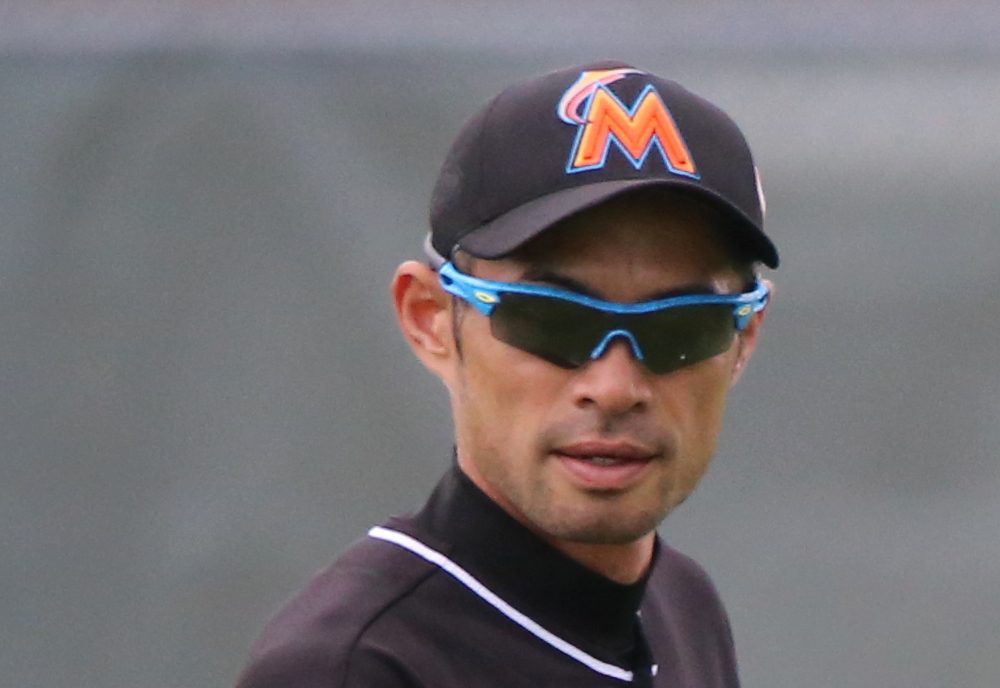
The next stop was Miami, where he joined the Marlins for the 2015 season. By then, the daily chase was no longer about batting titles or MVP voting. It was about longevity, craftsmanship and a place in one of baseball’s most exclusive clubs.
On August 7, 2016, he lined a triple off Chris Rusin of the Rockies for his 3,000th MLB hit. It was a fitting way to get there: not with a towering home run, but with a ball in play and legs still moving. He became the 30th player in major league history to reach the milestone.
Ichiro spent three seasons with Miami, from 2015 through 2017, batting .255 with 219 hits in a reduced role. Those numbers were modest compared with his peak, but they were never really the point. The larger total kept growing, and so did the sense that his career had become something broader than a standard MLB résumé.
He finished in the majors with 3,089 hits, a .311 batting average, 117 home runs, 780 RBI, 509 stolen bases and 1,420 runs scored. He is one of the few players in MLB history to combine at least 3,000 hits with 500 stolen bases.
Back where he belonged
His final chapter took him back to Seattle. The Mariners brought him home in 2018, and the return felt right even before the last game arrived. He appeared in the opening series of the 2019 season in Tokyo, a setting that gave the ending a rare sense of symmetry: the Japanese star who changed MLB for position players closing his playing career on home soil.
After those games against Oakland, he retired. It was March 2019, and the scene was unmistakably his. Seattle remained the franchise most closely tied to his name, and he later stayed with the organization as a special assistant to the chairman.
Records, honors and Hall of Fame recognition
The headline achievements are easy to list, but together they still carry force. Ichiro won AL MVP and Rookie of the Year in 2001. He was a 10-time MLB All-Star, a 10-time Gold Glove winner and a two-time American League batting champion. In Japan, he won seven batting titles, three Pacific League MVP awards and a Japan Series title.
He also starred internationally. Ichiro helped Japan win the World Baseball Classic in 2006 and 2009, and his go-ahead hit in extra innings against South Korea in the 2009 final remains one of the signature moments of his national-team career.
The record book gives the cleanest summary. He owns the MLB single-season hits record with 262 in 2004. He holds the major league record with 10 straight 200-hit seasons. Combine his NPB and MLB totals, and his 4,367 hits stand as the most in top-level professional baseball.
Ichiro Suzuki was elected to the National Baseball Hall of Fame in 2025. He was also inducted into the Japanese Baseball Hall of Fame the same year.
How he played
Calling him a contact hitter is true, but incomplete. He was a leadoff man who could control an at-bat, spoil pitches, slap the ball into open space and force defenders to hurry even on routine grounders. His speed mattered not only on stolen-base attempts but on everything else: first-step pressure, infield hits, extra bases taken almost before outfielders had settled the ball in their gloves.
In right field, he paired range with one of the most recognizable throwing arms of his era. The 10 consecutive Gold Gloves were not ceremonial. He cut down runners, changed decisions and made the position feel active.
He was also remarkably durable. For a decade in Seattle, his game was built on repetition and availability as much as flair. Day after day, the same swing path, the same pregame work, the same narrow margin for error mastered again.
Off the field
Away from baseball, Ichiro has generally kept his private life tightly controlled, which makes the confirmed details stand out more clearly. He married Yumiko Fukushima, a former TBS announcer, in 1999. Reports have long described the ceremony as private, with Los Angeles chosen in part to avoid intense media attention in Japan.
His father’s influence remained a frequent subject throughout his career, sometimes admiringly and sometimes with more tension in later reporting about their relationship. Where those accounts go beyond public baseball history, they are best treated cautiously. What is firmly established is that the training structure at home shaped the player the world came to know.
Commercially, he became one of the most marketable athletes Japan produced in his generation. He had endorsement deals with brands including Nike, Mizuno, Asics, Kirin and Nintendo. Salary and earnings estimates vary by source, especially once sponsorships and his years in Japan are included, but published figures place his MLB salary earnings at well over $170 million.
FAQ
How many hits did Ichiro Suzuki have?
He had 3,089 hits in MLB and 4,367 combined hits across NPB and MLB.
What teams did Ichiro play for in Major League Baseball?
He played for the Seattle Mariners, New York Yankees and Miami Marlins.
Did Ichiro Suzuki win an MVP award?
Yes. He won the American League MVP in 2001 and also won three Pacific League MVP awards in Japan.
What record does Ichiro hold for hits?
He holds the MLB single-season hits record with 262 in 2004.
When did Ichiro get his 3,000th MLB hit?
He reached 3,000 MLB hits on August 7, 2016, while playing for the Miami Marlins.
Is Ichiro Suzuki in the Hall of Fame?
Yes. He was inducted into both the National Baseball Hall of Fame and the Japanese Baseball Hall of Fame in 2025.
Photo: Arturo Pardavila III on Flickr (Original version)…, CC BY 2.0, via Wikimedia Commons