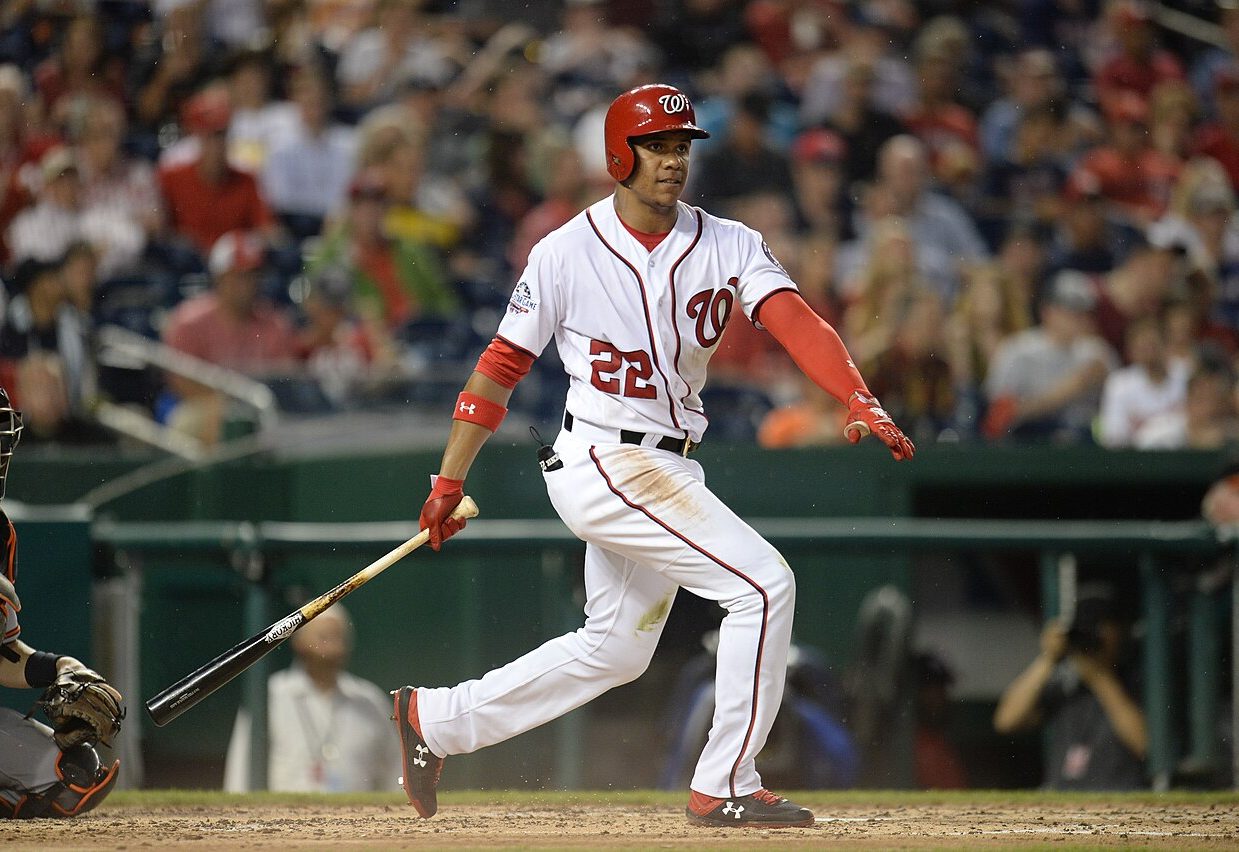
Nineteen years old, no fear, and already working counts like a veteran. That was the first real shock of Juan Soto’s arrival in Washington: not just the power, but the calm. Pitchers tried to rush him, expand the zone, test whether a teenager would chase. He usually didn’t. From the start, Soto looked like he understood the strike zone on a different level.
From Santo Domingo to pro ball
Juan José Soto Pacheco was born on October 25, 1998, in Santo Domingo, Dominican Republic. Baseball was part of the family rhythm. His father, Juan Soto Sr., had played catcher in a local league, and that influence showed up early in the way Soto learned the game. He grew up with his mother, Belkis Pacheco, his older sister, Natali, and his younger brother, Elian Soto, who later signed with the Nationals organization.
One childhood detail has followed him for good reason. Soto has spoken about playing improvised baseball indoors with rolled-up paper and tape, turning hallways into basepaths. His father also encouraged him to hit and throw left-handed, even though he was naturally right-handed. That choice helped shape the player he became: a lefty bat with unusual balance, whip and plate coverage.
Like many Dominican kids of his generation, he looked up to stars from home and around the league, including Manny Ramírez and Robinson Canó. When he moved into professional baseball, he also made a point of learning English, a practical step that teammates and coaches often noticed.
The Washington Nationals signed him as an international free agent in July 2015 for a reported $1.5 million bonus. From there, his climb was fast. He moved through the Gulf Coast League, Auburn, Hagerstown, Potomac and Harrisburg, hitting enough at every stop to make the next assignment feel inevitable.
Washington’s teenage phenom
Soto’s big-league debut came in 2018, and he did much more than survive. In 116 games, he hit .292 with 22 home runs, 70 RBI, a .406 on-base percentage and a .923 OPS. He finished second in National League Rookie of the Year voting, but the larger point was obvious by then: Washington had found a middle-of-the-order hitter years ahead of schedule.
The age made the numbers stand out even more. As a teenager, he posted one of the best offensive seasons in recent memory, showing advanced swing decisions and a willingness to take walks that older hitters often spend years trying to learn. He drew 79 walks that season, a remarkable total for any rookie, let alone one who was still too young to order a drink in the United States.
Then came 2019, the season that turned promise into October weight. Soto hit .282 with 34 home runs and 110 RBI during the regular season, helping anchor a Nationals club that surged after a rough start. In the postseason, he was central to the run rather than merely along for it. Washington won the first World Series title in franchise history, and Soto hit .333 in the Series with 3 home runs and 7 RBI. He shared the Babe Ruth Award as the postseason’s outstanding performer.
That championship remains the defining team achievement of his career. It also fixed his reputation early: this was not just a gifted young hitter piling up regular-season numbers, but a player comfortable on the biggest stage.
The bat kept getting louder
The shortened 2020 season was one of the purest offensive displays of Soto’s career. In 47 games, he batted .351 with 13 home runs, 37 RBI, a .490 OBP, a .695 slugging percentage and a 1.185 OPS. He won the National League batting title and also led the league in on-base percentage, slugging and OPS.
Even in a shortened schedule, the quality of the at-bats stood out. Soto was not simply hot. He was dictating plate appearances, forcing pitchers into mistakes and punishing them when they came back into the zone.
In 2021, he followed with another elite season: .313, 29 home runs, 95 RBI, and an MLB-leading 145 walks. That walk total was the highest in the majors since Barry Bonds drew 232 in 2004, and it underlined what separated Soto from many other sluggers. He was not built around chasing damage. He was built around waiting for the right pitch and doing damage then.
He also made the first of several All-Star teams and again led the NL in on-base percentage. By this point, the shape of his offensive identity was clear. Power mattered, but patience was the engine.
The difficult Washington exit and the move to San Diego
Before the 2022 season, Soto agreed to a one-year, $17.1 million contract with Washington to avoid arbitration. During that stretch, multiple outlets reported that he turned down a 15-year, $440 million extension offer from the Nationals. Soto later spoke openly about how hard that period was, saying the trade process weighed on him emotionally.
The trade finally came in August 2022, when Washington sent him to the San Diego Padres in one of the biggest deadline deals in recent memory. By the time he left, he had already become the youngest player in Nationals history to reach 100 career home runs.
His overall 2022 line between Washington and San Diego was still productive, but the split told the story of transition. In 52 games with the Padres, he hit .236 with 6 home runs and 16 RBI. The adjustment was real. So was the spotlight. Even in the middle of that upheaval, he won the 2022 Home Run Derby, a reminder of how visible his talent had become.
San Diego kept him on a one-year, $23 million deal for 2023, again avoiding arbitration. That season looked much more familiar: .275 batting average, 35 home runs, 109 RBI, and another league lead in walks. He was back to looking like himself, controlling counts and getting on base at an elite clip.
One big year with the Yankees
The next stop was the Bronx. Soto spent the 2024 season with the New York Yankees, and the fit was obvious from the start. In a lineup built for pressure, patience and power, he hit .288 with 41 home runs and 109 RBI while leading the American League in runs scored.
His postseason gave him another signature moment. In ALCS Game 5 against Cleveland, he hit a go-ahead three-run homer in the 10th inning, one of those swings that instantly becomes part of a player’s highlight reel. By the end of that postseason, his career playoff résumé had grown to 43 games with 11 home runs and 30 RBI.
He also earned All-Star honors again and was named to the All-MLB First Team. For a one-season stay, it was a loud one.
The Mets contract and a new chapter in New York
In December 2024, Soto changed the financial landscape of the sport. He signed a 15-year, $765 million contract with the New York Mets, including a $75 million signing bonus. At the time of the agreement, it was widely reported as the largest contract in professional sports history.
That deal naturally became part of every Juan Soto conversation, but it did not change the basic scouting report. The Mets were paying for one of the game’s most reliable offensive stars: a hitter who combines power with elite on-base skill and rarely looks rushed.
He wears No. 22, the same number closely associated with him throughout his career. One small off-field story that circulated among teammates involved Soto giving a gift, reportedly including a watch, to help secure that jersey number from a new clubmate. It was a minor clubhouse anecdote, but it fit the image of a player aware of his own brand without making a spectacle of it.
What makes Juan Soto different
Plenty of hitters can slug. Fewer can control an at-bat the way Soto does. His game starts with strike-zone judgment, and almost everything else flows from there. He takes walks, works deep counts and forces pitchers to throw competitive strikes. When they do, he has the bat speed and balance to drive the ball to all fields.
That approach is why his on-base percentages keep landing among the league leaders. It is also why he remains dangerous even when the home runs come in waves rather than every week. A slump for Soto can still include hard contact, long at-bats and traffic on the bases.
Then there is the visual trademark: the Soto Shuffle. The routine in the box, the stare, the movement, the little bursts of body language after a close pitch, became one of baseball’s most recognizable habits. It can look playful from a distance, but it serves a competitive purpose. Soto turns the at-bat into a conversation, sometimes almost a dare, and he is comfortable making pitchers feel that.
Defensively, he has spent most of his career in the corner outfield, primarily left field and right field. His value has always been tied first to the bat, but the complete player is easier to appreciate when you watch a full series rather than a stat line.
Family, charity and life away from the field
Off the field, family remains central to Soto’s story. His father’s baseball background helped shape his mechanics and mindset, and his younger brother’s path into professional ball extended the family’s connection to the game.
He has also made notable charitable gestures. In 2021, Soto donated his All-Star Game and Home Run Derby earnings, roughly $200,000, according to published reports, to Dominican Olympic athletes. It was a direct contribution to sports in his home country, and one of the clearer examples of how he has used his platform.
As for his private life, public reporting has been limited. Various outlets have described him as single, but relationship details should be treated cautiously unless Soto confirms them himself. A personal preference he reportedly discussed in an interview has circulated online, but that is not the same thing as a confirmed relationship and should be understood as such.
Honors that match the production
The awards and milestones have stacked up quickly. Soto was the NL Rookie of the Year runner-up in 2018, a World Series champion in 2019 and a Babe Ruth Award winner that same postseason. He won the NL batting title in 2020 and has collected multiple Silver Slugger Awards and All-Star selections, along with repeated All-MLB recognition.
The league leads tell the same story more cleanly than any slogan could. He has led his league in on-base percentage multiple times, topped the walks leaderboard more than once, and in 2024 led the American League in runs scored. Those categories fit him because they reflect his real strengths: patience, impact and consistency.
And that is the through line of his career so far. Juan Soto arrived young, but he never played young at the plate. From Washington to San Diego to the Yankees and then the Mets, the style has held. He slows the game down, wins the count, and makes pitchers deal with him on his terms.
FAQ
What team does Juan Soto play for?
Juan Soto plays for the New York Mets.
Where is Juan Soto from?
He was born in Santo Domingo, Dominican Republic.
Has Juan Soto won a World Series?
Yes. He won the 2019 World Series with the Washington Nationals.
What is the Soto Shuffle?
It is Soto’s signature batter’s-box routine, featuring body movement and reactions after pitches, especially close takes.
When did Juan Soto make his MLB debut?
He made his major league debut with the Washington Nationals in 2018.
How much is Juan Soto’s Mets contract?
He signed a 15-year, $765 million contract with the Mets in December 2024.
Photo: All-Pro Reels from District of Columbia, USA, CC BY-SA 2.0, via Wikimedia Commons