
Fifty home runs and fifty stolen bases had never belonged in the same season until Shohei Ohtani did it in Dodger blue. By then, the larger point of his career was already clear: the sport kept running out of categories for him.
Born on July 5, 1994, in Mizusawa, now part of Oshu in Iwate Prefecture, Ohtani grew into baseball’s rare modern two-way star, a left-handed hitter and right-handed pitcher who carried elite power and top-end velocity in the same frame. Long before the Los Angeles Dodgers gave him a record-setting contract, he had already become one of the most unusual players the game had seen, with MVP awards in the majors and a championship pedigree that started in Japan.
A baseball childhood in Iwate
Baseball arrived early in Ohtani’s life and never really left the center of it. His father, Toru, coached him when he was young, and stories from those years helped shape his image in Japan as a kid who seemed to live at the ballpark. One often-cited example came in junior high, when he reportedly recorded 17 of 18 outs in a regional championship game.
He attended Hanamaki Higashi High School, a program well known in Japanese baseball circles, and quickly stood out not just for his size but for the scale of his talent. He did not take the college route. Instead, he moved straight toward professional baseball, already carrying the kind of attention usually reserved for polished prospects years older.
That next step came in the 2012 NPB draft, when the Hokkaido Nippon-Ham Fighters selected him in the first round. It was the start of the first major chapter of the Shohei Ohtani story.
The Fighters years: proving the two-way idea could work
Ohtani joined the Fighters in 2013 and stayed through 2017. Those seasons mattered because they turned a fascinating amateur into a real professional force, and because they gave him room to keep developing as both a pitcher and a hitter instead of forcing an early choice.
He was named an NPB All-Star multiple times during his years with the club, and his pitching numbers soon gave the profile real weight. In 2015, he posted a 2.24 ERA. In 2016, he was even sharper, finishing at 1.86. That season remains one of the defining years of his career in Japan: he won Pacific League MVP and helped the Fighters win the Japan Series.
By the time he left Nippon Professional Baseball, Ohtani was no longer just a domestic star with tools. He was a genuine baseball event, the kind of player scouts, executives, and fans discussed in terms of possibility as much as production. Could this really work in Major League Baseball too? That question followed him across the Pacific.
Shohei Ohtani and the move to MLB
On December 9, 2017, Ohtani signed with the Los Angeles Angels. Because of MLB’s international signing rules, he arrived not as a conventional free agent in his prime but through the league’s international bonus system, a detail that only added to the attention around him. The intrigue was obvious: plenty of Japanese stars had crossed over successfully, but none had tried to do it this way, as a true two-way player.
The experiment did not take long to look real.
In 2018, Ohtani hit .285 with 22 home runs and a .925 OPS in 104 games, while also making 10 starts on the mound and posting a 3.31 ERA with 63 strikeouts in 51.2 innings. He was named American League Rookie of the Year, and the award felt less like a surprise than a confirmation that his game translated.
Injuries complicated the next stretch. He underwent Tommy John surgery after that rookie season, which limited his pitching and forced the Angels to manage his workload carefully. Even so, the larger idea survived. He was still dangerous at the plate, still electric on the mound when healthy, and still unlike anyone else in the league.
The Angels years and the season that changed everything
Then came 2021, the year Ohtani stopped being treated mainly as a novelty and started being discussed as one of the best players in baseball, full stop.
He hit 46 home runs, drove in 100 runs, stole 26 bases, and as a pitcher struck out 156 batters with a 3.18 ERA over 130.1 innings. No single stat can fully explain that season because the achievement was in the overlap. He was doing star-level work in two jobs at once. That summer, he became the first player in MLB history to be named an All-Star as both a pitcher and a position player. At season’s end, he won the AL MVP unanimously and received the Commissioner’s Historic Achievement Award.
That was the breakthrough year, but it was not a one-off.
In 2022, he kept building on it, and in 2023 he produced another MVP season. He hit 44 home runs, led the American League in that category, and went 10-5 with a 3.14 ERA and 167 strikeouts in 132 innings. He won the AL MVP unanimously for the second time and became the first Japanese-born player to win an MLB home run title.
The same year, he also starred for Japan in the World Baseball Classic and was named tournament MVP. The image that lasted was fittingly dramatic: Ohtani on the mound, closing out the title game against Team USA by striking out Mike Trout.
By the end of his Angels run, from 2018 through 2023, he had done more than answer the original question. He had changed the way the sport thought about roster construction, player development, and what one superstar could reasonably be asked to do.
The Shohei Ohtani contract and a new Dodgers chapter
The next move landed with the force of a franchise-altering event. In December 2023, Ohtani signed a 10-year, $700 million deal with the Los Angeles Dodgers, the largest contract in baseball history at the time.
The structure drew almost as much notice as the headline number. The agreement included heavy deferrals: $2 million in annual salary during the playing years of the contract and $68 million per year in deferred payments afterward. For weeks, the Shohei Ohtani contract was discussed not only in baseball terms but in financial ones.
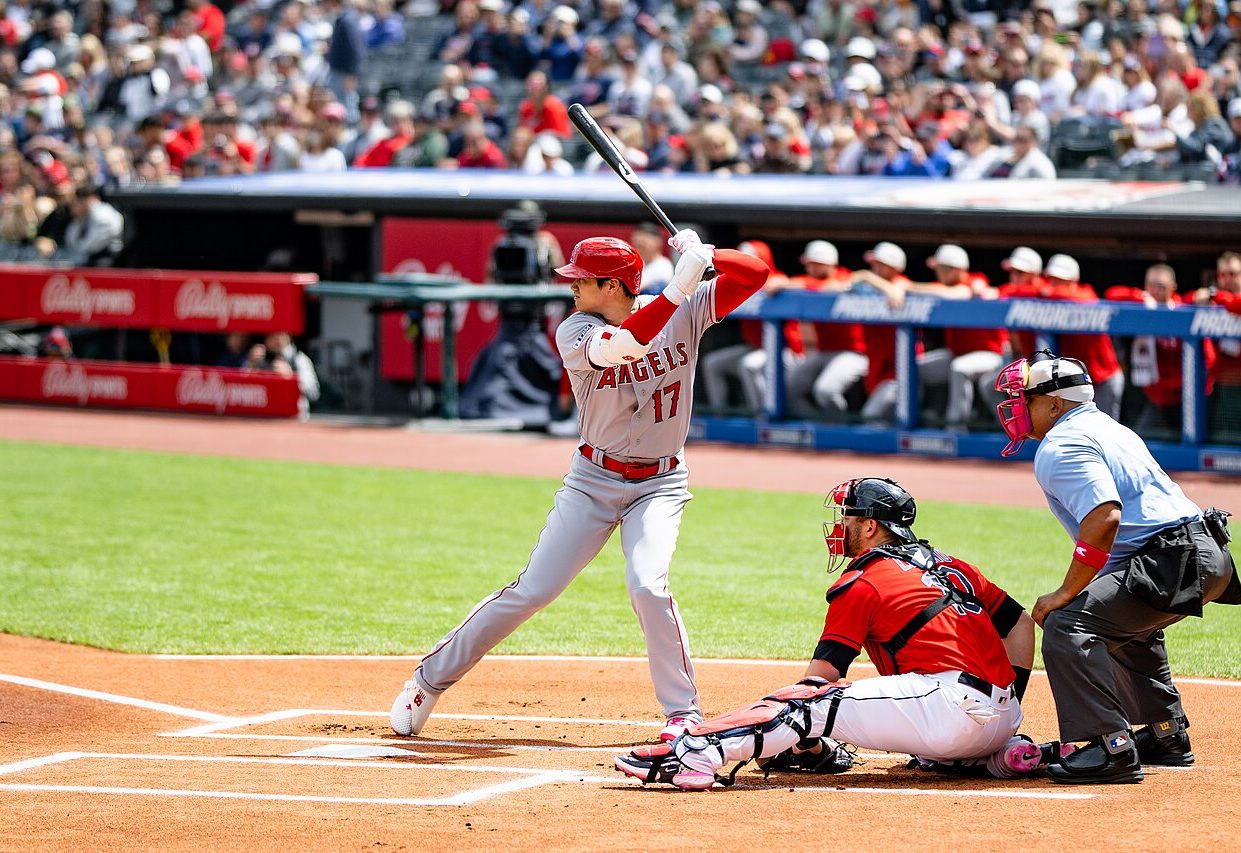
He also arrived with a familiar number. Ohtani wore No. 17 with the Dodgers, and one small story from that transition made the rounds when he gifted a Porsche to the wife of reliever Joe Kelly after Kelly gave up the number.
A first Dodgers season for the record books
Ohtani did not pitch in his first season with the Dodgers while recovering from elbow surgery, but even as a designated hitter only, he produced one of the loudest offensive seasons the sport has seen.
In 2024, he hit .310 with 54 home runs and 59 stolen bases, becoming the first player in MLB history to reach 50 home runs and 50 steals in the same season. He won the National League MVP unanimously. The Dodgers went on to win the World Series, giving him his first championship in the majors.
That year added another layer to his career. Ohtani had already proven he could be baseball’s best two-way player. In 2024, he showed that even stripped down to one role, he could still dominate the sport as an everyday offensive force.
What makes Ohtani different
At 6-foot-4 and around 210 pounds, Ohtani looks the part of a middle-of-the-order slugger. Then he takes the mound and throws like a frontline starter.
He bats left-handed and throws right-handed, and his game has always been built on unusual range. At the plate, he can drive the ball out to any part of the park and punish mistakes with top-tier exit velocity. On the mound, his fastball has reached triple digits, and his splitter has long been one of his defining weapons.
That is why the usual comparisons tend to fall short. Most stars are measured against players who share their job description. Ohtani has spent much of his career forcing baseball to compare him across roles. He has been judged as a designated hitter, as a starting pitcher, and as a player whose very existence changes how a team can use its roster.
The list of firsts reflects that reality. He became the first modern full-time two-way star in the majors, the first All-Star selected as both pitcher and position player, the first Japanese-born MLB home run champion, and the first player to post a 50-50 season.
Life away from the field
For someone this famous, Ohtani has kept much of his private life unusually quiet. What is public tends to come in careful glimpses rather than constant exposure.
His parents are Kayoko and Toru Ohtani, and he has two older siblings, Yuka and Ryuta. In early 2024, he announced that he had married Mamiko Tanaka, a former professional basketball player in Japan. Reports later indicated the couple welcomed their first child, a daughter.
He is also closely associated with his dog, Decoy, known in Japan as Decopin, a detail that has become part of his public image almost as much as any endorsement campaign.
His charitable work has been more concrete than performative. After the end of the 2023 season, he donated 60,000 youth baseball gloves to elementary schools across Japan. In early 2024, he and the Dodgers pledged $1 million for earthquake relief in Japan. Published reports also noted a $500,000 donation to support wildfire victims in Southern California. He has been linked with support for Japan Heart, a medical nonprofit, and his name has increasingly appeared around youth-focused philanthropy.
One off-field story did break through in a very different way. In March 2024, Ohtani’s former interpreter, Ippei Mizuhara, became the focus of a major gambling and theft investigation. Ohtani was not charged, and federal investigators said he had been the victim of a large-scale theft, but the case became one of the most scrutinized episodes surrounding his career because his public life had otherwise been so controlled and so quiet.
As for internet speculation about where his “real home” might be, including claims tied to anonymous online comments, that remains rumor and not established fact.
Shohei Ohtani’s place in the game
The awards help tell the story, but they are not the whole story. Ohtani won AL MVP in 2021 and 2023, both unanimously, then added a unanimous NL MVP in 2024. He also won the 2023 World Baseball Classic MVP and helped the Dodgers to a World Series title in 2024.
Those honors matter because they came in different forms of excellence. He has been the best hitter in a league, one of the best pitchers when healthy, and the rare player who can alter the shape of a lineup and a pitching staff at once. That is a different kind of value from the usual superstar template.
The simplest way to put it is probably still the most accurate. Shohei Ohtani did not just revive the idea of the two-way player. He made it credible at the highest level of the sport.
FAQ
What is Shohei Ohtani’s nickname?
“Shotime” is the best-known nickname. Fans have also called him “Goatani,” and “Unicorn” is a common description of his rare two-way skill set.
What team does Shohei Ohtani play for?
He plays for the Los Angeles Dodgers.
Is Shohei Ohtani really a two-way player?
Yes. He has starred in MLB as both a hitter and a pitcher, which is what makes him so unusual.
How much is Shohei Ohtani’s contract?
He signed a 10-year, $700 million contract with the Dodgers in December 2023.
Where is Shohei Ohtani from?
He was born in Mizusawa, now part of Oshu, in Iwate Prefecture, Japan.
Has Shohei Ohtani won a World Series?
Yes. He won his first World Series title with the Dodgers in 2024.
Photo: Erik Drost, CC BY 2.0, via Wikimedia Commons