
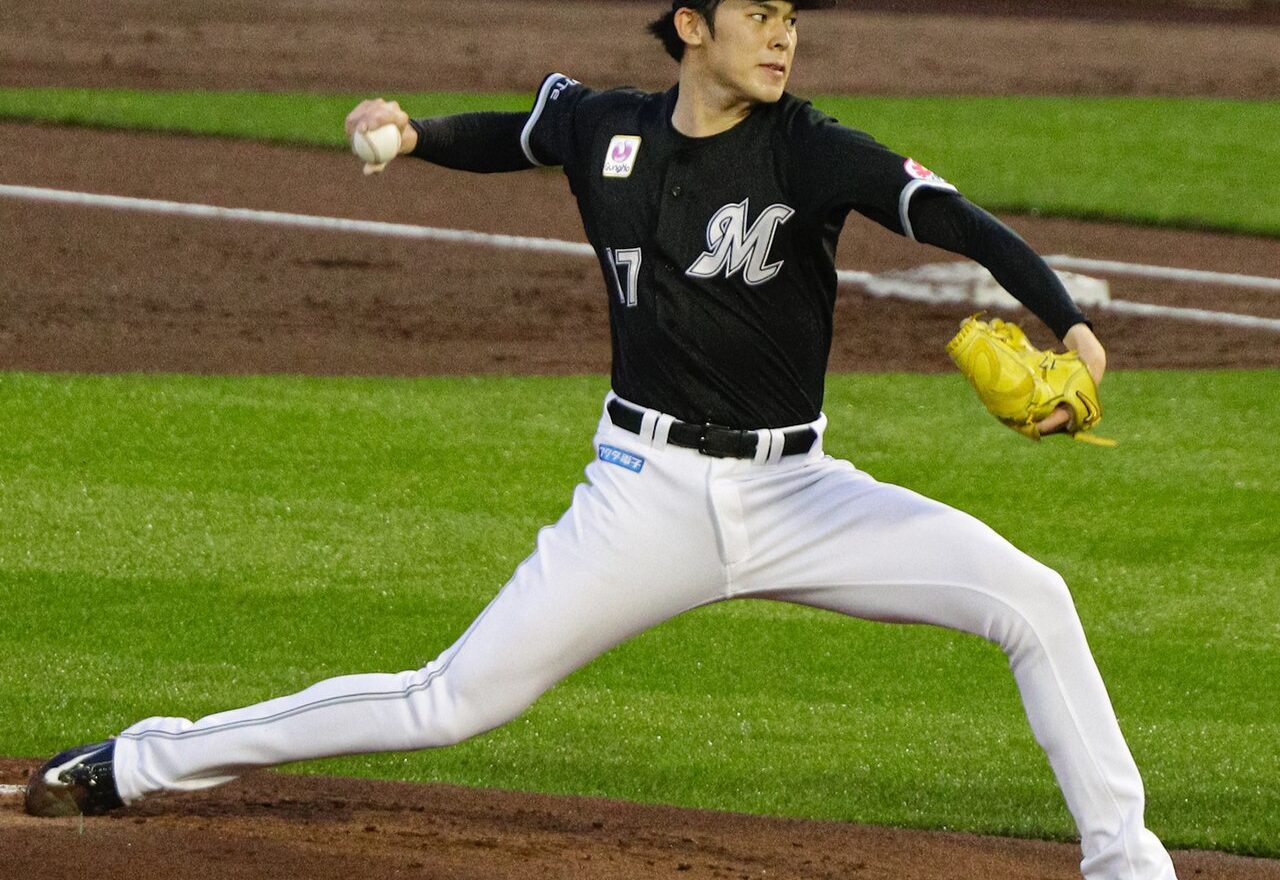
At 20 years old, Roki Sasaki threw a perfect game and struck out 19 hitters in the same afternoon. That was the day his talent stopped being a projection and became a matter of record.
Born on November 3, 2001, in Rikuzentakata, Iwate, Japan, Sasaki grew up in a place that would shape the rest of his life. He was 9 when the 2011 Tohoku earthquake and tsunami devastated the region. His father, Kota, and his paternal grandparents died in the disaster, and the family home was destroyed. His mother, Yoko, raised Sasaki and his two brothers after the family resettled in Ofunato. That history has remained central to any honest account of him, not as mythology, but as fact.
Baseball came alongside that grief and rebuilding. Sasaki later attended Ofunato High School, where his arm quickly made him one of the most closely watched young pitchers in Japan. Reports at the time said he had chances to join more established baseball powers, but stayed local instead. By his final high school summer, the radar gun was already flashing numbers rarely seen from a teenager. He was clocked at 163 km/h, roughly 101 mph, surpassing the previous widely noted Japanese high school mark associated with Shohei Ohtani.
That same summer also brought the first national debate around how he should be handled. In the 2019 Iwate tournament final, Ofunato manager Hiroshi Kokubo chose not to use Sasaki after heavy workloads earlier in the event. The decision was criticized in some corners, but it also fit a larger question that would follow him into pro ball: how do you protect a rare arm without dulling what makes it rare?
One small detail from his early life often gets mentioned because it is unusual enough to stick. According to Japanese media reports, his given name was inspired by a villain character named Rouki in Hyakujuu Sentai Gaoranger.
Drafted first, developed carefully
The Chiba Lotte Marines selected Sasaki with the first pick in the 2019 NPB draft. For a pitcher with that kind of velocity, the temptation to rush him would have been obvious. The Marines did the opposite.
He did not pitch in NPB in 2020, and when he finally reached the top team in 2021, the usage was measured. Sasaki made his NPB debut on May 16, 2021, against the Seibu Lions. The approach looked cautious at the time. It also proved sensible.
Instead of being pushed immediately into a full ace workload, he was allowed to build strength and rhythm. That slower path matters in the story of his career. He was not a prodigy dropped into the deep end. He was developed with unusual restraint, then exploded.
The Chiba Lotte years and the perfect game
From 2021 through 2024, Sasaki pitched for the Marines and produced the kind of line that explains why MLB clubs tracked him so closely: 29-15, a 2.10 ERA, 505 strikeouts, and a 0.89 WHIP in 394 2/3 innings.
The signature performance came on April 10, 2022, against the Orix Buffaloes. Sasaki threw a perfect game, the youngest pitcher in NPB history to do it, at 20 years and 5 months. He struck out 19, tying the NPB single-game record, and set a world-recognized mark by striking out 13 consecutive batters.
He nearly turned it into something even stranger. In his next start, he opened by retiring the first 17 hitters he faced before being removed. Across those two outings, he retired 52 straight batters, an NPB record.
That stretch changed the scale of the conversation around him. Before then, Sasaki was the young Japanese pitcher with elite velocity and a devastating splitter. After it, he was attached to one of the most remarkable sequences the sport had seen in years.
His honors followed naturally. He was named an NPB All-Star in 2022 and 2023. In 2023, he again reminded everyone that the fastball was not just famous because of one high school summer. On April 28 of that season, he hit 165 km/h, or 102.5 mph, tying the fastest pitch recorded by a Japanese pitcher in NPB.
World Baseball Classic stage
By the time the 2023 World Baseball Classic arrived, Sasaki was no longer simply a domestic star. He was part of a Japan roster packed with elite talent and high expectations.
He pitched for Japan in that tournament and helped the team win the championship. The event mattered because it placed him in a different frame. He was not just overpowering NPB hitters anymore; he was on an international stage, sharing a staff and clubhouse with some of the biggest names in the sport. For many fans outside Japan, it was the clearest look yet at why the interest in Roki Sasaki had grown so intense.
Why MLB teams wanted him
The appeal was never just radar-gun theater. Sasaki’s profile as a pitcher was unusually complete for someone so young.
He works from a three-quarters slot and attacks with a fastball that has lived in the upper 90s and touched 102.5 mph. The splitter is the out pitch, diving under barrels and producing empty swings. He also mixes a hard slider. Velocity gets the headlines, but the shape of his success has always been broader than that. The strikeout totals, the low WHIP, the low ERA in Japan, and the ability to dominate lineups without much hard contact all point to a pitcher whose stuff translated into results.
That is why the phrase Roki Sasaki stats usually leads back to more than one number. The perfect game stands out, of course, but so do the strikeouts, the efficiency, and the way hitters so often looked late on the fastball and helpless against the splitter.
Move to the Los Angeles Dodgers
Sasaki signed with the Los Angeles Dodgers on January 22, 2025. Because he moved under international amateur rules, the structure of the deal was limited compared with what a fully open major league free agent might command. He received a $6.5 million signing bonus and began on a minor league contract before joining the club.
There was also outside reporting about the market around him. According to The Athletic, the San Diego Padres were reportedly prepared to offer more than $10 million in bonus money. That figure has been widely reported, but it should be treated as reported interest rather than a confirmed formal offer accepted or rejected on the record.
Once in Los Angeles, he took uniform No. 11. One of his first small clubhouse moments became a telling one: after Miguel Rojas gave up the number, Sasaki thanked him with sake and glasses. It was a modest gesture, but a memorable one, and it fit the early impression he made with the Dodgers as reserved, polite, and deliberate.
Early Dodgers years
The start of his MLB career did not mirror the near-immediate statistical dominance he had shown in Japan. That is not unusual, and in his case it was part of the adjustment.
In his first season with the Dodgers, he was on a club that won the World Series. Team success came quickly, even as his own transition to the majors asked for patience. Through August 13, 2026, his MLB line stood at 6-6 with a 4.43 ERA and 142 strikeouts in 152 1/3 innings. For the 2026 season through mid-August, he had logged 105 innings with a 4.54 ERA, 9.1 strikeouts per nine innings, and 3.4 walks per nine.
Those numbers showed the same swing-and-miss ability, but not yet the same level of command and suppression he had in NPB. That is the honest reading of the early Roki Sasaki Dodgers chapter: the stuff remained evident, the strikeouts were there, and the adaptation was still in progress.
One anecdote from that period captured how he approached those adjustments. During a rough stretch, Sasaki said he revisited video of himself from high school while trying to recover lost velocity and feel. It was not a dramatic reinvention, just a pitcher looking backward to find the simplest version of his delivery.
Life away from the mound
The most important off-field fact in Sasaki’s story is also the hardest one. The 2011 tsunami did not just touch his life; it broke it apart and forced his family to rebuild. He has returned to Rikuzentakata in the offseason, and his public comments over the years have shown that the disaster is not a background detail to him.
When wildfires struck the Los Angeles area, Sasaki spoke with empathy about families dealing with sudden loss and displacement, drawing on his own experience. That kind of connection helps explain why his story has resonated beyond baseball circles.
In April 2025, he publicly announced that he was married. Beyond that announcement, he has kept his private life largely private, and there is little value in stretching beyond what he has chosen to share.
A few lighter details round out the picture. He was reportedly named after a television villain. He stayed with a local high school program instead of chasing a bigger baseball brand. And early in his Dodgers tenure, he made a point of thanking a veteran teammate for a jersey number with a gift rather than a speech. None of that changes the stat line, but it does make the profile feel more human.
FAQ
When was Roki Sasaki born?
Roki Sasaki was born on November 3, 2001.
Where is Roki Sasaki from?
He was born in Rikuzentakata, Iwate, Japan.
Did Roki Sasaki throw a perfect game?
Yes. He threw a perfect game for the Chiba Lotte Marines on April 10, 2022.
How fast is Roki Sasaki’s fastball?
His fastball has reached 102.5 mph, or 165 km/h.
What team does Roki Sasaki play for?
He plays for the Los Angeles Dodgers.
Is Roki Sasaki married?
Yes. He announced in April 2025 that he was married.
Photo: とらとうはんしん, CC BY 4.0, via Wikimedia Commons