
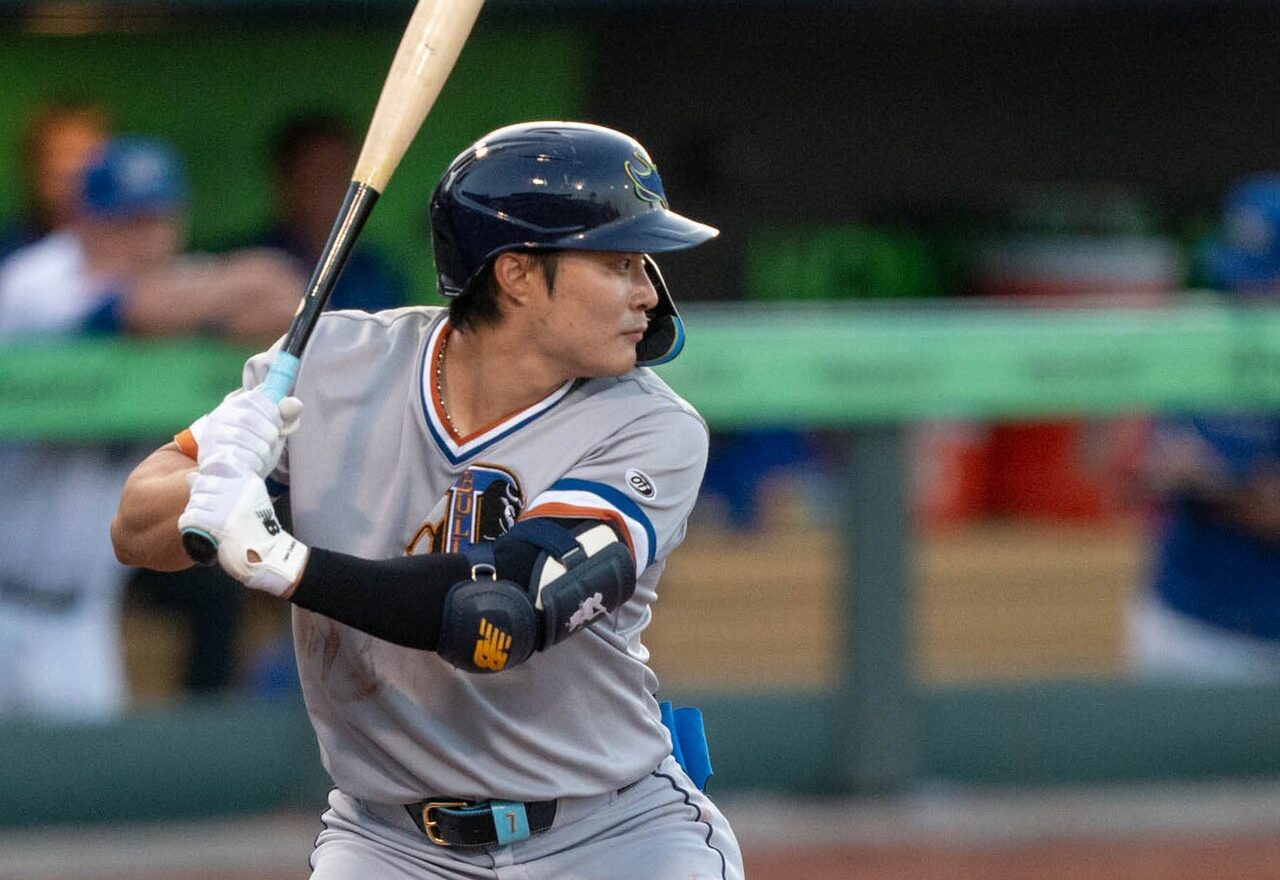
Three Golden Gloves in Korea, one Gold Glove in the majors, and a career built on clean reads, quick feet and quiet consistency. That is the outline of Ha-Seong Kim’s baseball life, but the full story has more texture than a list of awards.
Born on October 17, 1995, in Bucheon, Gyeonggi Province, Kim grew into one of South Korea’s best all-around infielders before carrying that game to Major League Baseball. At 5-foot-10 and around 200 pounds, he never fit the old stereotype of the oversized power bat or the glove-only shortstop. Instead, he became the kind of player managers trust all over the infield: shortstop, second base, third base, wherever the game asks.
Early years in South Korea
Kim was the youngest of three children and came through Yatap High School in Seongnam, one of the better-known baseball programs in the country. He helped the school finish runner-up in a national tournament in 2013, and he also appeared for South Korea at the 2013 18U Baseball World Cup.
That same period established him as a serious professional prospect. In the 2014 KBO Draft, the Nexen Heroes selected him in the third round, 41st overall. He was still a teenager, stepping into a league where middle infielders are expected to defend first and earn everything else later.
He did both.
Making his name with the Heroes
Kim played for the Heroes organization from 2014 through 2020, first as a Nexen player and later, after the club’s name change, with Kiwoom. Over those seven seasons, he developed from a promising young infielder into one of the KBO’s most productive everyday players.
His final KBO line tells the story clearly: a .294 batting average, 133 home runs and 575 RBI. For a player whose defensive value was obvious from the start, that offensive production mattered. He was not simply surviving at shortstop. He was driving games.
One early marker stood out. As a teenager, Kim became the sixth player in KBO history to reach double-digit home runs before turning 20. That gave a hint of what was coming: a middle infielder with more impact at the plate than many expected.
The awards followed. He won the KBO Golden Glove Award three straight times, in 2018, 2019 and 2020. Those honors reflected the full package rather than one flashy skill. Kim could defend, run, make contact and hit for enough power to change innings.
His international résumé grew at the same time. He won gold with South Korea at the 2018 Asian Games, silver at the 2017 Asia Professional Baseball Championship, and silver again at the 2019 WBSC Premier12. At that Premier12 tournament, he was also named to the All-World Team at shortstop.
The Asian Games title had an important off-field consequence as well: it earned him an exemption from South Korea’s standard military service requirement, a major detail in the careers of many Korean athletes.
The details that shaped his public image
Baseball careers are remembered through odd little moments as much as through stat lines, and Kim picked up a few of those in Korea.
In 2015, he changed his jersey number from 0 to 7, the number he had worn in high school. In 2018, he injured his hand while cleaning up a broken flower pot at home, an incident that led to the nickname “Kim Hwa-bun,” a reference to the flower pot. Another nickname, “Guraseong,” reportedly grew out of a 2016 spring-camp episode in which he took a lie-detector test multiple times.
Some of the other nicknames attached to him over the years have circulated more loosely in fan culture than in formal reporting, so they are better treated as informal labels rather than established parts of his public identity.
Crossing to Major League Baseball
On December 31, 2020, Kim signed with the San Diego Padres on a four-year, $28 million contract. It was a significant move for both sides. For Kim, it was the jump from one of Asia’s strongest leagues to the daily grind of the majors. For San Diego, it brought in a Korean infielder with a strong defensive reputation and a track record of production.
His first MLB season in 2021 was an adjustment year, as it often is for players changing leagues, pitching styles and routines. He did not arrive as a finished offensive product, but his defense translated quickly. That was the first clear sign that his game would hold up in the majors even while the bat caught up.
By 2022, he had become a more central piece of the Padres’ infield mix. He was a Gold Glove finalist that season, and his value was easy to spot even on nights when he did not fill the box score. He moved well, handled different positions, and gave San Diego options without costing the club defense anywhere on the dirt.
Then came his best all-around major league season.
The 2023 breakthrough with the Padres
In 2023, Kim hit .260 with 17 home runs, 60 RBI and 38 stolen bases for San Diego. He paired that with standout defense and won the National League Gold Glove Award at utility, becoming the first Korean-born player to win an MLB Gold Glove.
That season captured what makes him useful. He was not a one-tool player. He could draw walks, put the ball in play, steal a base, take an extra base, and slide from shortstop to second or third without much drop-off. Over a long season, that kind of versatility has real value.
He followed that with a more uneven offensive year in 2024, batting .233 with 11 home runs, 47 RBI and 22 stolen bases. Even then, his plate discipline remained a strength. He continued to show the patient, selective approach that had helped him become more than a defense-first infielder.
A move after San Diego
After the 2024 season, Kim reached free agency. Reports tied him to a number of clubs, but the next confirmed step was his agreement with the Tampa Bay Rays. He signed a two-year, $29 million contract on February 3, 2025.
His time with Tampa Bay was brief. In 191 plate appearances for the Rays, he batted .234 with five home runs and six stolen bases before moving on again later that season.
He then joined the Atlanta Braves. In 24 games with Atlanta, he hit .253 with three home runs and 12 RBI. During one September stretch, he scored a run in nine straight games, a reminder that even in short samples he can affect games with movement, timing and awareness rather than brute force alone.
Because roster and contract details can change quickly, any description of his current team status should be checked against the latest official club records. The supplied version of this biography listed him with Atlanta and wearing No. 7, but one claim in the original draft was incorrect: Walt Weiss was not the Braves’ manager. That detail has been removed.
What kind of player is Ha-Seong Kim?
Kim’s style tends to look better over a week than in a single highlight clip. He is a right-handed hitter and thrower whose best work often starts with positioning and reaction time. At shortstop, second base or third, he has built his reputation on first-step quickness, reliable hands and a strong enough arm to finish plays from different angles.
Offensively, he has usually profiled as a contact-oriented hitter with patience and enough pop to punish mistakes. He is not a classic middle-of-the-order slugger, but the power is real enough to matter, as his 17-homer season in San Diego and his 133 KBO home runs showed.
The broader point is this: Ha-Seong Kim has lasted and succeeded because he does many things well. He can help a lineup without carrying it, and he can stabilize an infield without needing daily attention for it.
Off the field
Kim’s off-field profile has generally been light on spectacle and heavy on small, memorable stories: the flower-pot injury, the number switch back to 7, the spring-camp lie-detector episode. Those details have followed him because they fit the image of a player whose public persona is more understated than dramatic.
One more serious matter did become public in 2024. On August 30, South Korean reports said Kim won a lawsuit against former baseball player Lim Hye-dong for breach of contract, with the court ordering Lim to pay 800 million won. Because legal reporting can be complex across jurisdictions and translations, it is best framed as a reported court ruling rather than embellished beyond the published facts.
Beyond that, there is little reason to overstate his private life. The available public record says far more about his baseball than about any off-field celebrity image, and that suits the player he has been: durable, adaptable and usually more noticeable after nine innings than before first pitch.
FAQ
How old is Ha-Seong Kim?
Ha-Seong Kim was born on October 17, 1995.
What position does Ha-Seong Kim play?
He is primarily an infielder and has played shortstop, second base and third base.
Has Ha-Seong Kim won a Gold Glove?
Yes. He won an MLB Gold Glove as a utility player in 2023, the first Korean-born player to do so.
Which KBO team did Ha-Seong Kim play for?
He played for the Nexen Heroes, later renamed the Kiwoom Heroes, from 2014 through 2020.
What teams has Ha-Seong Kim played for in MLB?
He played for the San Diego Padres and later for the Tampa Bay Rays and Atlanta Braves, according to the supplied career timeline.
What stands out most about Ha-Seong Kim’s game?
His versatility. He brings strong infield defense, good instincts, plate discipline and enough speed and power to contribute in several ways.
Photo: Minda Haas Kuhlmann, CC BY 4.0, via Wikimedia Commons