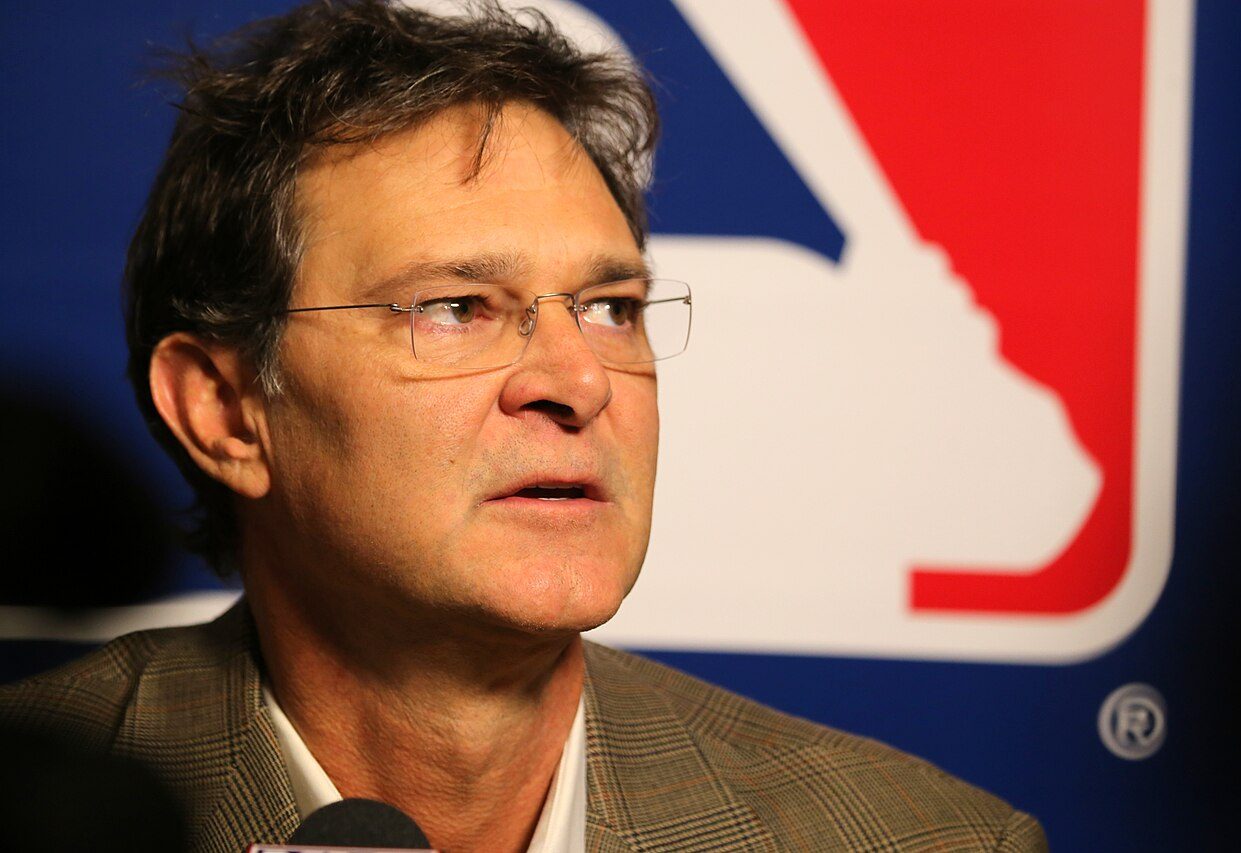
Fifty-three doubles in one season still stand as a Yankees record. That number says plenty about Don Mattingly: line drives instead of empty loft, authority without excess, and a game built as much on precision as power.
For a stretch in the mid-1980s, Mattingly was the face of the Yankees on a club that often had stars but not always stability. He hit for average, piled up hits, won Gold Gloves at first base, and in 1985 took home the American League MVP award. He also spent his entire major league playing career with one team, which gave his rise and decline a rare continuity. By the time he later won National League Manager of the Year, his baseball life had already covered more ground than most careers do.
Evansville roots and a multi-sport start
Donald Arthur Mattingly was born on April 20, 1961, in Evansville, Indiana. He grew up in a large family with parents Bill and Mary Mattingly, brothers Jerry, Randy, and Michael, and sister Judy.
Before pro baseball narrowed his path, he was the kind of athlete who seemed to fit anywhere. At Reitz Memorial High School in Evansville, he played baseball, quarterbacked in football, and handled point guard duties in basketball. Those details matter because they help explain the balance in his game later on. He was not just a hitter with quick hands; he was an all-around athlete with body control, instincts, and coordination.
One of the better stories attached to his development comes from backyard baseball. Mattingly learned to drive the ball the other way in part because of a tree he had to avoid. Whether told as family lore or hitting lesson, it fits the player he became: a left-handed batter comfortable using the whole field, not merely trying to yank everything into the right-field seats.
Indiana State offered him a scholarship, but pro ball arrived first. In the 1979 MLB draft, the Yankees selected him in the 19th round, 493rd overall.
A steady climb through the Yankees system
Mattingly was not an instant phenom in New York. He moved through the farm system one level at a time, playing for Oneonta in 1979, Greensboro in 1980, Nashville in 1981, and Columbus from 1982 into 1983.
That progression shaped the player who reached the majors. The profile was already visible: low strikeout totals, hard contact, advanced feel for hitting, and unusually polished defense for a young first baseman. He was not built around flash. He was built around repeatability.
He made his major league debut with the Yankees on September 8, 1982. In those first seasons he wore No. 46 before switching to the No. 23 that would become closely tied to his name.
Don Mattingly becomes the Yankees’ centerpiece
By 1984, Mattingly had moved from promising young hitter to one of the best players in the American League. He won the AL batting title that season with a .343 average and led the league with 207 hits and 44 doubles. A year later, he was even better where voters tend to notice it most: run production.
In 1985, he hit .324 with 35 home runs, 145 RBIs, 211 hits, and 48 doubles, winning the AL MVP award. He also led the league in RBIs, total bases, and sacrifice flies. The numbers were big, but the style was what made him memorable. He was a middle-of-the-order hitter who did not need to sell out for strikeouts or uppercut power. He could beat pitchers with timing, barrel control, and relentless hard contact.
From 1984 through 1989, he made six straight All-Star teams. He led the American League in doubles three straight times from 1984 to 1986. In 1986, he set a Yankees single-season record with 53 doubles and led the majors with 238 hits. At first base, he paired that offense with elite defense, winning nine Gold Gloves overall: five straight from 1985 through 1989, then four more from 1991 through 1994. He also won three consecutive Silver Slugger awards from 1985 through 1987.
That combination made him unusual even in a star-heavy era. He was not simply a hitter who happened to play first base well enough. He was one of the position’s best defenders while carrying the offensive burden expected from the spot.
The 1987 streak and a strange grand slam record
One of the sharpest snapshots of Mattingly at full force came in 1987. He tied a major league record by homering in eight consecutive games. In the same season, he hit six grand slams, tying the MLB single-season mark at the time.
The odd twist is that those six grand slams were the only grand slams of his major league career. Baseball produces strange little statistical corners like that, and this is one of the most famous attached to Mattingly’s name.
The contract, the back trouble, and the turn in his career
In April 1990, Mattingly signed a five-year, $19.3 million contract with the Yankees. At the time, it made him the highest-paid player in the sport.
But that period also marked the point where his career changed. Chronic back problems began to limit him, and the version of Mattingly who had dominated the middle of the decade became harder to sustain over a full season. He went on the injured list in 1990 and underwent extensive treatment. The issue never fully disappeared, and it became the central fact of his later playing years.
There is also a long-circulating story that he hurt his back during clubhouse horseplay with pitcher Bob Shirley in June 1987. That anecdote has been widely repeated over the years, but both Mattingly and Shirley denied it, so it should be treated as a reported story rather than established fact.
Even with the physical decline, he remained productive. He adjusted, relied more on craft than force, and continued to provide value with his glove and bat. The peak had passed, but the player was still there.
One October chance, and a memorable one
For all his individual success, Mattingly never played in a World Series. That remains one of the enduring ironies of his career, especially for someone so closely identified with the Yankees.
He did finally reach the postseason in 1995, his final season. In the AL Division Series against Seattle, he hit .417 with a home run, four doubles, and six RBIs. It was his only postseason appearance, but it was not a quiet one. In a short series, he looked like himself again: sharp, dangerous, and fully at home in big moments.
After the Yankees lost that series in five games, Mattingly retired. His major league playing career ran from 1982 through 1995, all with New York.
He finished with a .307 batting average, 2,153 hits, 222 home runs, 1,099 RBIs, and an .830 OPS. Those numbers do not tell the whole story of his peak, but they frame it well enough.
Number 23, Monument Park, and his place in Yankees history
The Yankees retired Mattingly’s No. 23 and dedicated his plaque in Monument Park in 1997. He remains a rare figure in franchise history: a player deeply associated with the team’s identity despite never winning a championship with it.
That says something about how he was viewed in New York. Fans did not remember him only as a stat line. They remembered the batting stance, the sideburns controversy under George Steinbrenner, the smooth work around first base, the line drives into the gaps, and the sense that for several years he was the club’s most dependable presence.
He has been inducted into the Indiana Baseball Hall of Fame and several minor league or regional halls, but not the National Baseball Hall of Fame. His Cooperstown case has long been debated, with supporters pointing to the quality of his peak and detractors to the shorter prime caused by injury.
Back in uniform: coach, manager, and another award
Retirement did not end Mattingly’s life in baseball. He later served as a hitting coach and bench coach with the Yankees before moving into managing. He managed the Los Angeles Dodgers from 2011 through 2015, then the Miami Marlins from 2016 through 2022.
In the pandemic-shortened 2020 season, he was named National League Manager of the Year after guiding Miami to the postseason. That gave him a rare combination of honors: MVP as a player, Gold Gloves in the field, and Manager of the Year in the dugout.
A factual correction matters here: Mattingly is not the interim manager of the Philadelphia Phillies. He joined the Toronto Blue Jays coaching staff before the 2023 season and has served as the club’s bench coach.
How Don Mattingly played
Mattingly’s game was built on balance. He hit for average, drove balls into the gaps, and rarely looked overmatched. At his best, he was one of the toughest hitters in the league to strike out and one of the most reliable at turning a hittable pitch into a hard line drive.
The power was real, especially in his peak years, but it was not the cartoon version often associated with first basemen. His extra-base damage came heavily through doubles, and that fit his swing. He stayed through the ball, used left-center field, and let his hands do the work.
Defensively, he was outstanding. The nine Gold Gloves were not decorative awards. He had soft hands, excellent footwork around the bag, and a knack for helping infielders by turning imperfect throws into outs. Managers and teammates tend to notice those details immediately, even when they do not make nightly highlights.
Off the field: family, business, and a quieter public image
Away from the field, Mattingly’s public life was usually low-key. He has children, including Taylor Mattingly and Preston Mattingly, the latter of whom also played professional baseball. Public records and published profiles have long documented his family background, but Mattingly generally kept the spotlight on baseball rather than celebrity.
In 1987, he opened a restaurant in New York called Mattingly’s 23, a fitting side venture for a player whose popularity in the city was then at its height. He also appeared in public-service work, including spots connected to the “True Dads” campaign.
There are a few personal details that have lasted because they sound like baseball stories should sound: the high school quarterback, the point guard, the kid who could throw with either hand in Little League, the hitter who learned to go the other way because of a backyard tree. They do not need embellishment. They already explain plenty.
FAQ
What was Don Mattingly’s nickname?
The best-known nickname is “Donnie Baseball.” He was also called “The Hit Man.”
What team did Don Mattingly play for?
He spent his entire MLB playing career with the New York Yankees, from 1982 to 1995.
Did Don Mattingly win an MVP award?
Yes. He won the American League MVP in 1985.
Is Don Mattingly in the Hall of Fame?
He is not in the National Baseball Hall of Fame.
What number did Don Mattingly wear?
He wore No. 46 early in his Yankees career, then No. 23, which the Yankees later retired.
What is Don Mattingly doing now?
He has worked as a coach after his managing career and has served as bench coach for the Toronto Blue Jays.
Photo: Arturo Pardavila III from Hoboken, NJ, USA, CC BY 2.0, via Wikimedia Commons