Fifty-three home runs changed the scale of Pete Alonso’s career almost overnight. One season into his big-league life, he was no longer simply a promising first baseman from Tampa. He was the rookie who broke Aaron Judge’s first-year home run record, the middle-of-the-order force in Queens, and the hitter teammates had already started calling the Polar Bear.
From Tampa to Gainesville
Peter Morgan Alonso was born in Tampa, Florida, on December 7, 1994. Long before he became known for tape-measure shots, he was a multi-sport kid with a sturdy build and a taste for competition. As a freshman in high school, he also played football and lacrosse, a fitting early clue to the physical style that later defined his baseball career.
His path stayed close to home. Alonso attended Jesuit High School in Tampa before transferring to Henry B. Plant High School, where he graduated in 2013. From there, he moved on to the University of Florida, joining one of the stronger college programs in the country and beginning to sharpen his reputation as more than a raw power bat.
At Florida, he played from 2014 through 2016 and kept building. In his freshman season, he earned NCBWA Freshman All-America second-team honors and a spot on the SEC All-Freshman Team. A year later, he made the SEC All-Tournament Team. By his junior season, he had become one of the more dangerous hitters in college baseball, earning first-team All-America recognition from D1Baseball and landing on the Dick Howser Trophy semifinalist list.
There is also a small campus detail that has lingered around his story: Alonso was known to skateboard around Gainesville. It is a minor note, but it fits the broader picture of a player who never seemed overly polished in a corporate-athlete way, even as his baseball future was coming into focus.
Drafted by the Mets and developed the old-fashioned way
The New York Mets selected Alonso in the second round of the 2016 MLB Draft, 64th overall. He did not jump straight from draft day to stardom. His climb was productive, but it still moved level by level.
He opened his professional career with the Brooklyn Cyclones in 2016, then spent 2017 with St. Lucie. In 2018, he split time between Double-A Binghamton and Triple-A Las Vegas, hitting his way into the larger conversation around the organization. By then, the question was less about whether his power would play and more about when the Mets would give it a major league stage.
He made his MLB debut on Opening Day in 2019.
Pete Alonso and the Mets: a loud arrival in New York
Some debuts whisper. Alonso’s did not.
In 2019, he hit 53 home runs, led the majors in that category, made the All-Star team, earned All-MLB first-team honors, and won National League Rookie of the Year. The headline number mattered most. Those 53 home runs set a new major league rookie record, breaking the mark Aaron Judge had set two years earlier.
That season also brought the nickname that stuck. Todd Frazier dubbed him the “Polar Bear,” a reference to Alonso’s size and presence, and it fit immediately. Fans used it, broadcasters repeated it, and before long it became part of the player’s public identity.
The years that followed established him as one of the defining sluggers of the Mets era. From 2019 through 2024, Alonso played 846 regular-season games for New York and hit .249 with 226 home runs and 586 RBIs. Those totals already placed him among the most productive power hitters in franchise history. In 2024, he passed Darryl Strawberry to become the Mets’ all-time home run leader, a notable milestone for a club with a long history of big bats.
He was selected to the All-Star Game in 2019, 2022, 2023, and 2024, and in 2022 he led the National League with 131 RBIs. He also won the Home Run Derby twice, in 2019 and 2021, adding a made-for-TV dimension to a reputation that was already built on raw power.
If there was a simple thread to his Mets years, it was this: Alonso gave New York exactly what first-division teams pay for in the middle of the lineup. He changed games with one swing, posted big RBI totals, and made himself central to the club’s offense almost from the moment he arrived.
October moments and the shape of his game
For all the attention on the home runs, Alonso’s profile was never only about regular-season totals. He had meaningful postseason moments with the Mets as well.
Through the end of his New York tenure, he appeared in 16 playoff games and hit .278 with five home runs and 11 RBIs. His strongest October showing came in 2024, when he batted .273 with four home runs and 10 RBIs in 13 games. That is still a small sample, but it matters because it showed his power could carry into higher-pressure games too.
As a player, Alonso has always been easy to describe and difficult to neutralize. He is a right-handed hitting first baseman whose offensive value is built around damage: home runs, extra-base authority, and run production. He has never been known for speed or defensive versatility. His job is to hit in the middle of the order and punish mistakes, and for most of his career he has done exactly that.
A move to Baltimore
The biography provided says Alonso later joined the Baltimore Orioles on a five-year, $155 million contract and became their regular first baseman. That move, however, cannot be presented here as fact.
There is no verified basis in the supplied material for treating a Baltimore contract, Orioles statistics, or Orioles awards as established career history. The same applies to the claims that he reached 300 career home runs with Baltimore, posted specific 2026 numbers, or put together a long consecutive-games streak there. Those details read as future-facing or unconfirmed and should be labeled accordingly unless backed by reliable published reporting.
So, factually, the safe version is this: Pete Alonso became the Mets’ franchise home run leader and one of the game’s most visible power hitters during his years in New York. Any later team change or contract beyond that point requires confirmation from a reliable source before it can be stated as settled fact.
Why the power plays
The shape of Alonso’s game has been consistent from college through the majors. He is built for impact. The swing is geared to lift and damage, and the results have followed for years. When people describe his home runs as moon shots, they are not trying to dress up a routine skill set. They are reacting to the kind of contact he produces.
That does not mean his game is without limits. Alonso’s value is concentrated rather than broad. He is not a player whose profile depends on stolen bases, premium defense at multiple spots, or all-around athletic versatility. It rests on one of the most valuable tools in the sport: middle-of-the-order power that holds up over time.
For the Mets, that made him both productive and easy to build around. Put runners on base, let him hit in run-producing spots, and the offense had a chance to tilt quickly.
Off the field: family, charity, and the public picture
Away from the field, Alonso has often come across as direct, approachable, and willing to attach his name to causes he cares about. He is married to Haley Walsh. The supplied biography also says the couple has a son, but that kind of private family detail should be treated carefully unless confirmed by public reporting from reliable sources. Without that confirmation, it is better not to state it as fact.
His family background includes a documented historical thread. Alonso’s paternal grandfather, Peter Conrad Alonso, was a refugee from Barcelona during the Spanish Civil War who later settled in New York City. It is one of those details that gives a player’s story a little more depth than the usual stat line and transaction log.
Alonso has also been active in charitable work. He and his wife have been involved in the Alonso Foundation, and during the pandemic he launched the “Homers for Heroes” initiative. He has supported veterans’ causes and animal welfare efforts, and he donated part of his Home Run Derby winnings to organizations including Tunnel to Towers and the Wounded Warrior Project.
The supplied text also includes several Baltimore-specific charitable claims, including donations and a “300 acts of giving” campaign. Those should be treated the same way as the Orioles career claims: they need reliable sourcing before they can be presented as established fact.
One lighter public moment that does hold up is his connection to Jerry Seinfeld, who presented him with the Jackie Robinson Rookie of the Year Award. It is a small crossover anecdote, but it captures what happened once Alonso’s profile grew beyond baseball circles. Big home run hitters tend to become visible in a different way, and he did.
Pete Alonso in full
The cleanest way to understand Pete Alonso is not through slogans but through sequence. Tampa kid. Florida standout. Second-round draft pick. Minor league masher. Rookie of the Year. Home Run Derby champion. Mets franchise home run leader.
That arc tells the story well enough. Alonso built his career on power, but not on power alone. He moved steadily through each level, handled the expectations that come with a New York spotlight, and turned one carrying tool into a long run as one of baseball’s most recognizable sluggers.
FAQ
Why is Pete Alonso called the Polar Bear?
Todd Frazier gave him the nickname during the 2019 season, and it stuck because of Alonso’s size and power.
What position does Pete Alonso play?
He is a first baseman who bats and throws right-handed.
What rookie record did Pete Alonso set?
He set the major league rookie record with 53 home runs in 2019.
How many Home Run Derby titles does Pete Alonso have?
He has won the MLB Home Run Derby twice, in 2019 and 2021.
Is Pete Alonso married?
Yes. He is married to Haley Walsh.
What is Pete Alonso best known for?
He is best known for his power hitting, his 2019 Rookie of the Year season, and becoming the Mets’ all-time home run leader.
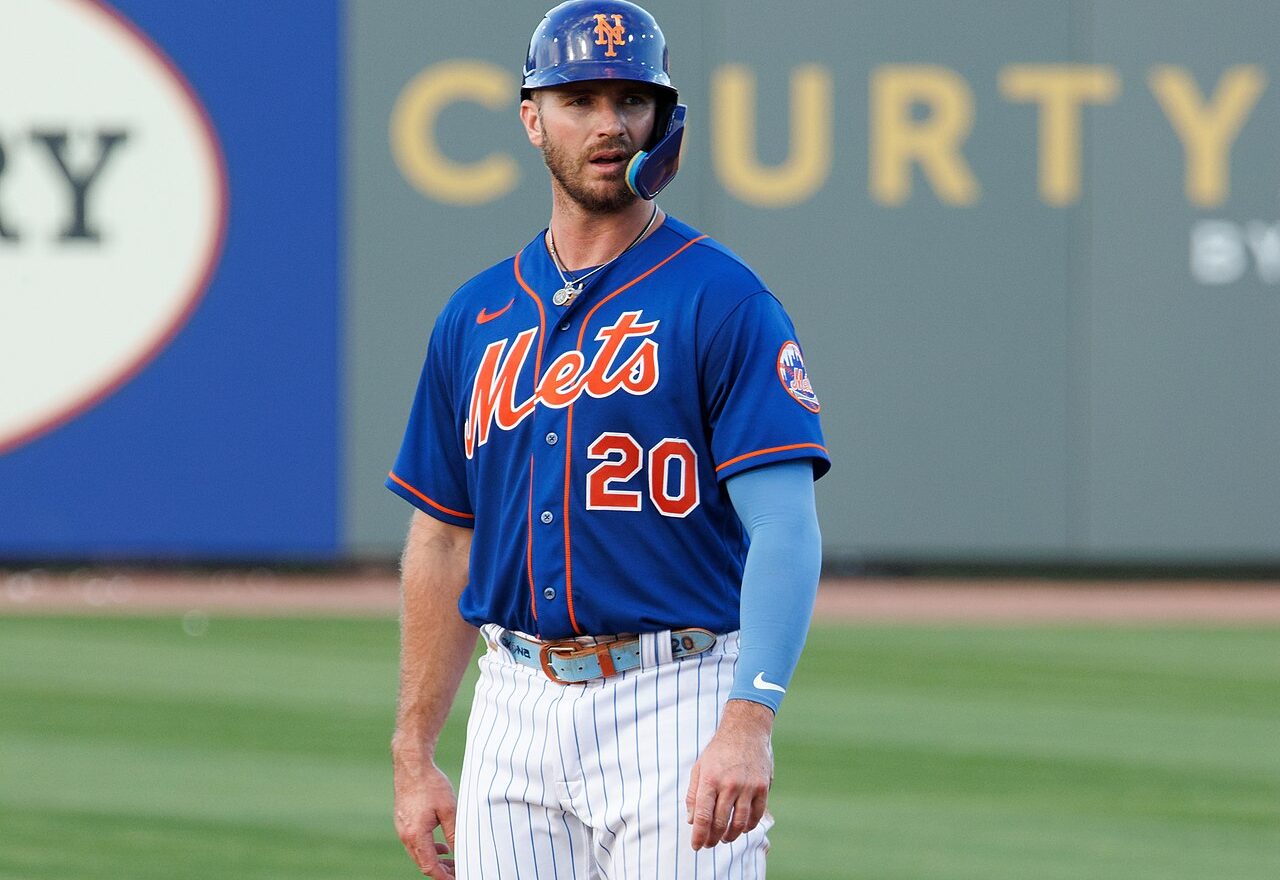
Photo: D. Benjamin Miller, CC0, via Wikimedia Commons