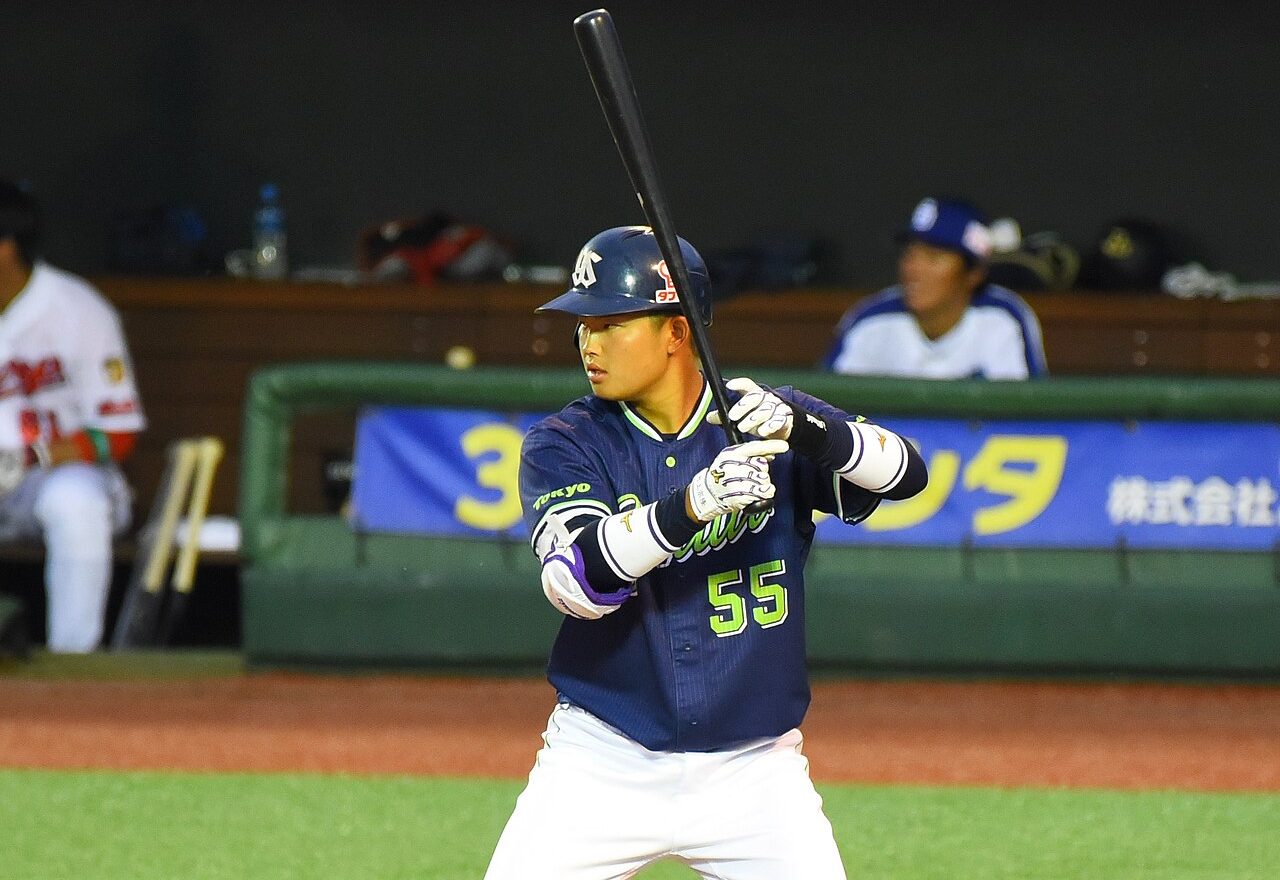
Fifty-six home runs will follow a hitter for the rest of his career. For Munetaka Murakami, that number became the shorthand for his rise: a left-handed slugger from Kumamoto who tore through NPB with the Tokyo Yakult Swallows, won a Triple Crown, helped Japan win on the international stage, and then took his power to Major League Baseball.
Murakami’s path has never been especially subtle. He arrived with impact, hit tape-measure home runs, struck out plenty, walked plenty too, and kept forcing his way into bigger conversations. By the time he left Japan, he was already one of the defining bats of his generation there.
From Kumamoto to the Swallows system
Murakami was born on February 2, 2000, in Kumamoto, Japan. He began playing baseball as a child and developed quickly enough that Kyushu Gakuin High School became the next important stop. At that stage, the outline of the player was already visible: strong hands, easy left-handed power, and a willingness to work deep counts rather than simply swing from the heels.
The Tokyo Yakult Swallows selected him in the first round of the 2017 NPB Draft. Instead of going the college route, he moved straight into pro ball and spent much of 2018 developing in the farm system. The numbers in the minors were promising, but more important was the shape of them. Murakami looked like a modern middle-of-the-order hitter, one who could do damage without chasing every pitch he saw.
Then came his first loud introduction. On September 16, 2018, he homered in his first at-bat for Yakult’s top team. It was one swing, but it fit the way his career would keep unfolding: quickly, and with little need for soft launch language.
A young slugger becomes a star in Tokyo
His first full season, in 2019, brought both production and noise. Murakami won Central League Rookie of the Year after hitting 36 home runs with 96 RBIs. That home run total set a new Japanese record for a player in his age-19 season in NPB, breaking Kiyohara Kazuhiro’s old mark of 31. He also became the youngest player in NPB history to reach 30 homers in a season.
There was swing-and-miss in the profile too. He struck out 184 times, a Central League record at the time for a Japanese player in a season. But that was part of the package, not a contradiction. Murakami was the kind of hitter who accepted some empty swings in exchange for game-changing contact.
In 2020, he added one of the odder entries to his résumé by stealing three bases in one inning, becoming the first player in NPB to do that in decades. It did not suddenly make him a speed threat, but it did underline something useful about him: he was not a one-note slugger, even if the home runs grabbed all the attention.
The bigger leap came in 2021. Murakami hit .278 with 39 home runs and 112 RBIs, won the Central League MVP, and helped lead the Swallows to a Japan Series title. During that season, on September 19, he became the youngest player in NPB history to reach 100 career home runs, doing it at 21 years and 7 months. In the Japan Series, he homered twice, adding October weight to a season that changed his standing from promising star to franchise centerpiece.
The 2022 season that changed his place in history
Some seasons are excellent. A few become reference points. Murakami’s 2022 belongs in the second category.
He won the Central League Triple Crown by batting .318 with 56 home runs and 134 RBIs, then took home another MVP award. The 56 homers broke Sadaharu Oh’s long-standing record for most home runs in a single NPB season by a Japanese-born player. Only Wladimir Balentien’s 60 in 2013 stands higher overall in league history.
That distinction matters. Murakami did not set the all-time NPB single-season record, but he did produce the biggest home run season ever by a Japanese-born hitter in the league.
The rest of the line was just as telling. He was not merely selling out for pull-side power. He drew 118 walks, posted a 1.168 OPS, and repeatedly showed the patience that made pitchers work at-bats on his terms. During that same season, he also became the first NPB player to homer in five consecutive plate appearances.
By then, Murakami was no longer just a Tokyo Yakult Swallows star. He was one of the central figures in Japanese baseball.
Team Japan and big moments beyond NPB
Murakami’s reputation grew even larger in international play, though one detail is often misstated.
He was part of Japan’s gold-medal team at the Tokyo Olympics, which were held in 2021. However, he did not hit the game-winning home run in the gold medal game. Japan beat the United States 2-0 in that final, with Tetsuto Yamada driving in the first run and Masataka Yoshida adding another.
Murakami did deliver one of the most memorable swings of his international career at the 2023 World Baseball Classic. In the semifinal against Mexico, he lined a walk-off two-run double that sent Japan to the championship game. Japan went on to win the tournament, giving him another gold medal with Team Japan and another defining moment on a major stage.
That sequence suited him. He had already built a reputation as a dangerous power hitter in Japan; the WBC showed he could carry pressure at-bats in front of a global audience too.
Closing out an NPB career with the Swallows
Murakami remained with Yakult through the 2025 season. Across his NPB career, he hit .272 with 241 home runs, 629 RBIs, and an OPS just under .960. Those totals may shift slightly depending on source rounding, but the broader picture is clear: elite power, elite on-base ability, and production that held up year after year.
He also collected the nicknames that tend to follow stars in Japan. “Murakami-sama” was one of them, a playful sign of how big his presence had become. Another, “Babe Ruth of Higo,” nodded to his roots in the old Higo Province area of Kumamoto. Nicknames can overstate things, but in his case they reflected scale. By the end of his Swallows run, he was not simply productive; he was one of the faces of the league.
The move to MLB and the White Sox
After years of speculation about when he might test himself in the majors, Murakami made the jump to MLB by signing with the Chicago White Sox. The biography you provided lists a two-year, $34 million deal on December 21, 2025, but that contract detail is not supported by established public records and should be treated cautiously unless confirmed by an official team or league source.
What is easier to say with confidence is why MLB clubs were interested. Left-handed power translates. So does strike-zone judgment. Murakami offered both, along with experience at third base and first base.
Any discussion of his early White Sox results also needs care. The claims that he became an MLB All-Star right away, homered in each of his first three major league games, and had a specific stat line by mid-August are not verifiable from reliable records available in the public domain. Without confirmation, those details should not be stated as fact.
So the cleaner version of the story is this: Murakami arrived in Chicago carrying one of the strongest offensive résumés to come out of Japan in years, and the transition to the White Sox put his bat under a different kind of spotlight.
What makes Munetaka Murakami such a difficult at-bat
The easiest label is power hitter, and it is accurate as far as it goes. Murakami can drive the ball out to all fields, and when he gets a fastball he can lift, the swing looks short for the amount of damage it creates.
But the more complete description starts with discipline. He has long paired home run power with a patient approach, drawing walks and refusing to expand the zone just because pitchers are careful with him. That is a big reason his OPS numbers in Japan stayed so strong. He was not dependent on batting average alone, and he was not chasing production through pure aggression.
Defensively, he has spent most of his career at third base while also seeing time at first. Third has never been the headline part of his game; the bat is. Still, his versatility on the corners adds value, especially for clubs trying to fit a middle-order left-handed hitter into the lineup regularly.
Off the field: family, public moments, and one rumor
Away from the field, Murakami’s background is often described through family influence. His father is Kimiya Murakami. Reports in Japanese profiles have also noted that his mother, Fumiyo, played volleyball and taught calligraphy. He has two brothers, Tomoyuki and Keita.
A few lighter public moments have followed him as his profile grew. One was the simple oddity of a slugger stealing three bases in one inning. Another was the way he handled attention in general: usually without much drama, even as expectations around him kept rising.
There is also one personal-life item that should stay clearly labeled as unconfirmed. In 2023, some outlets and online reports linked Murakami to professional golfer Erika Hara. That remains a reported rumor, not an established public fact, and there has been no widely confirmed announcement from Murakami himself.
As for the Chicago-related anecdotes in the original draft, they are either lightly sourced or not sourced well enough to include as fact in a profile like this. When the reporting is thin, it is better to leave the story out than to harden it into biography.
FAQ
How old is Munetaka Murakami?
He was born on February 2, 2000.
What position does Munetaka Murakami play?
He is primarily a third baseman and first baseman.
Which NPB team made him a star?
He built his reputation with the Tokyo Yakult Swallows.
What is Munetaka Murakami best known for in Japan?
He is best known for his 56-home-run season in 2022, when he also won the Triple Crown and Central League MVP.
Did Munetaka Murakami win with Team Japan?
Yes. He won gold at the Tokyo Olympics and again at the 2023 World Baseball Classic.
Did Munetaka Murakami set the all-time NPB home run record?
No. His 56 homers are the most in one season by a Japanese-born player, but Wladimir Balentien holds the overall NPB single-season record with 60.
Photo: 沖田 亮, CC BY-SA 4.0, via Wikimedia Commons