
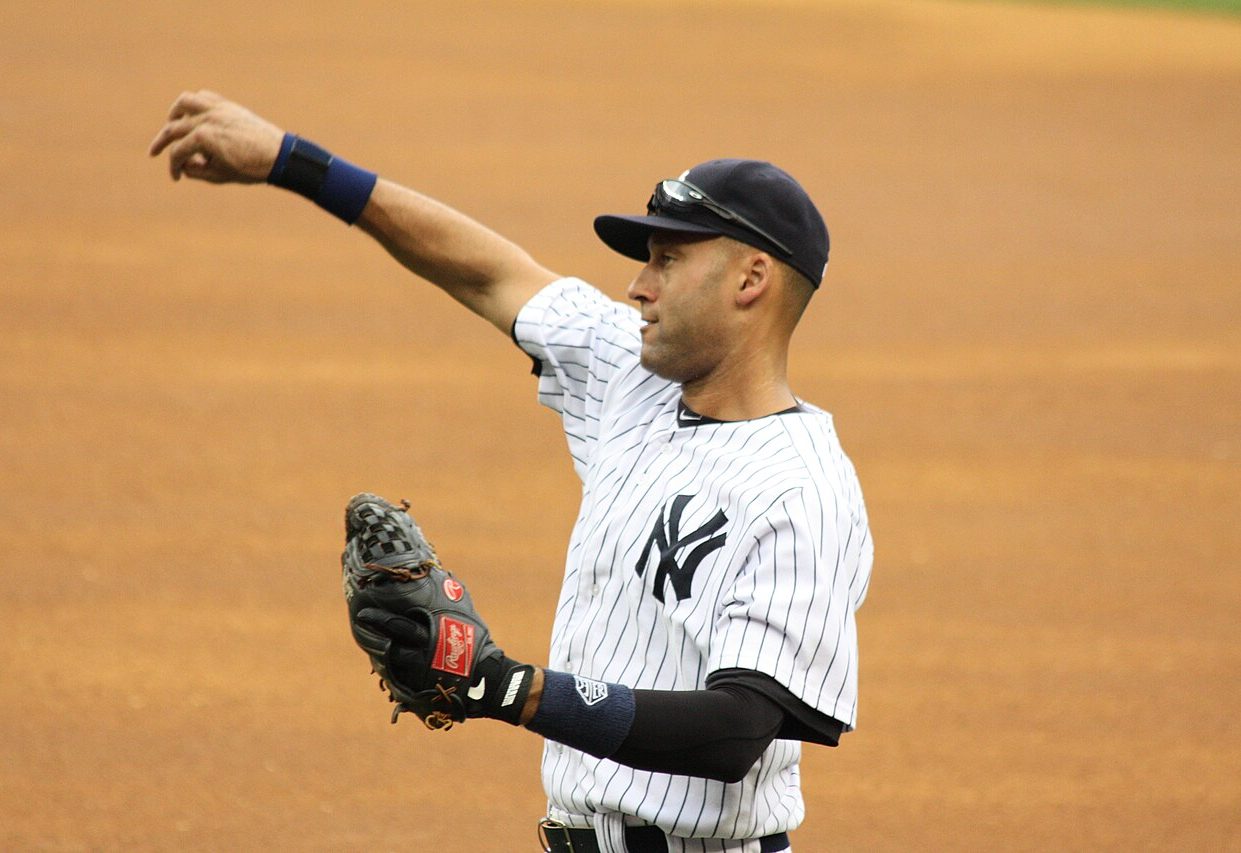
Five rings, 3,465 hits, one uniform. Derek Jeter’s career can be told through numbers, but the shape of it is really about permanence: a shortstop who arrived as a teenage first-round pick, grew into the center of the Yankees’ late-1990s dynasty, and stayed long enough to become the face of the franchise.
From New Jersey to Kalamazoo
Derek Sanderson Jeter was born on June 26, 1974, in Pequannock Township, New Jersey, and grew up in Kalamazoo, Michigan. His parents, Sanderson Charles Jeter and Dorothy Jeter, were a steadying influence early on. One family detail has followed him for years: they reportedly had him sign a yearly contract laying out expectations for behavior and schoolwork, a small window into the structure around his talent.
Sports came easily, but baseball was the clear pull. At Kalamazoo Central High School, Jeter played baseball and basketball, and he also ran cross country. He was a strong student too, a detail that fits the polished public image he later carried into the majors.
Long before he wore pinstripes, he was drawn to the Yankees. He has often spoken about admiring Dave Winfield, and family trips to Yankee Stadium helped turn that admiration into a real attachment. By the time pro scouts were circling, the connection was already there.
In the 1992 MLB Draft, the Yankees selected Jeter with the sixth overall pick in the first round. He had a scholarship offer from the University of Michigan, but pro ball won out. New York signed him for a reported $800,000 bonus, and the long relationship began.
Learning the game in the minors
The climb was not completely smooth at the start. Jeter debuted in the Gulf Coast League in 1992, then moved through the system with stops that included Greensboro, Tampa, Albany-Colonie, and Columbus. Early minor league numbers did not scream future Hall of Famer. What stood out instead was how quickly he adjusted.
By 1994, he was one of the top prospects in baseball. Baseball America named him Minor League Player of the Year after he hit .344 across three levels. The Yankees believed they had their shortstop of the future, and that belief hardened as his game rounded out: line-drive contact, smart baserunning, durability, and a calm feel for the position.
He made his major league debut on May 29, 1995. It was brief, just 15 games that season, but it put him on the doorstep. The full arrival came the next year.
Derek Jeter becomes the Yankees’ shortstop
In 1996, the Yankees handed the 22-year-old their everyday shortstop job. He answered with a .314 batting average, 10 home runs, 78 RBI, and 104 runs scored in 157 games. He won the American League Rookie of the Year award and helped New York win the World Series, the club’s first championship since 1978.
That season mattered for more than the trophy. It established the outline of the Derek Jeter career: present every day, productive at the plate, and comfortable on the biggest stage.
The Yankees soon became baseball’s dominant team, and Jeter was at the center of it. New York won the World Series again in 1998, 1999, and 2000, with the shortstop setting the tone at the top of the lineup. In 1999, he produced one of the best regular seasons of his career, batting .349 with 24 home runs, 102 RBI, 134 runs, and a .438 on-base percentage. He finished sixth in AL MVP voting, though his importance to the Yankees was already larger than any single ballot.
By 2000, he was no longer just a key player on a great team. He was one of the defining players of the era. That year he won both All-Star Game MVP and World Series MVP, a rare combination that captured how often he seemed to be in the middle of the action when the stakes rose.
October moments and the “Mr. November” swing
Jeter’s postseason record is one of the strongest ever assembled. Across 158 playoff games, he hit .308 with 200 hits, 111 runs, 32 doubles, 20 home runs, and 61 RBI. He retired as MLB’s all-time postseason leader in hits, runs, and games played.
The most famous moment came in Game 4 of the 2001 World Series. Because the series schedule had been pushed back after the September 11 attacks, the game crossed midnight before Jeter hit a walk-off home run off Byung-Hyun Kim. The calendar had flipped to November, and broadcaster Michael Kay’s call gave him a nickname that stuck: “Mr. November.”
It was a perfect baseball nickname because it came from one exact moment, not from marketing. Jeter had other labels over the years, especially “The Captain,” but “Mr. November” remains tied to that swing.
The captaincy and the long middle years
The Yankees named Jeter team captain in 2003, making him the first player to hold that title for the club since Don Mattingly. It fit the role he had already grown into. He was not a loud, theatrical leader. His style was steadier than that, more about routine, availability, and the expectation that important games would find him ready.
His prime stretched longer than most shortstops manage. He made 14 All-Star teams, won five Silver Slugger Awards and five Gold Gloves, and finished with a .310 career batting average. The Gold Gloves remain part of his résumé, though his defense has also been debated in later statistical analysis. What was never in doubt was his reliability, his internal clock on routine plays, and his ability to handle the position every day for two decades in New York.
His contract history reflected his standing in the organization. In February 2001, he signed a 10-year, $189 million deal. After that contract expired, he agreed to a three-year, $51 million contract in December 2010, then a one-year, $12 million deal in November 2013 for his final season.
There were injuries along the way, especially late. A broken left ankle suffered in the 2012 ALCS changed the close of his career and limited him badly in 2013, when he played only 17 games. But even that interruption did not erase the late-career reminder he had delivered the year before.
A final surge and the 3,000-hit milestone
On July 9, 2011, Jeter became the 28th player in major league history to reach 3,000 hits. He did it in ideal fashion for a player so closely tied to Yankee Stadium: a home game, a five-hit day, and a home run for the milestone hit. He finished that afternoon with 3,003.
Then came 2012, when many players at his age are hanging on rather than driving the game. Jeter led the majors with 216 hits and batted .316, showing that his bat remained a real weapon, not a ceremonial one.
He played his final season in 2014 after announcing before spring training that it would be his last. The farewell tour was large, but his play still supplied the cleanest ending. On September 25, 2014, in his final home game, he lined a walk-off single against the Baltimore Orioles at Yankee Stadium. Three days later, he played the last game of his career in Boston.
He retired with 3,465 hits, 544 doubles, 260 home runs, 1,311 RBI, 1,923 runs scored, and 358 stolen bases. He remains the all-time hits leader among shortstops and finished his career sixth on MLB’s all-time hits list at the time of his retirement.
Within Yankees history, his place is even larger. He retired as the franchise leader in hits, doubles, games played, stolen bases, at-bats, and plate appearances.
What made Derek Jeter work
Jeter’s game was built less on one overwhelming tool than on repeatable strengths. He used the whole field, handled velocity well, and had a knack for inside-out contact that sent countless hits to right field. He was a strong baserunner without being reckless, and he scored 100 or more runs in 13 seasons.
At shortstop, his style was athletic and instinctive rather than flashy for its own sake. The jump throw became one of his signatures, as did the backhand play in the hole. So did “The Flip” in the 2001 ALDS against Oakland, when he ranged toward the first-base line, took an errant relay, and flipped home to catch Jeremy Giambi at the plate. It remains one of the defining defensive plays of his career.
Leadership is harder to measure, but it is impossible to leave out of his profile. In a clubhouse full of stars, he became the constant. That mattered to the Yankees almost as much as the batting average.
Life away from the field
Off the field, Jeter kept a carefully managed public image. He married model Hannah Davis, now Hannah Jeter, in 2016. They have children together; reports and public coverage have identified daughters including Bella Raine, Story Grey, and River Rose. Because the family has generally kept private details limited, it is best to leave that part of the story there.
His charitable work has had a longer public footprint. In 1996, he founded the Turn 2 Foundation, focused on helping young people avoid drug and alcohol abuse and rewarding academic achievement. The foundation has raised and distributed millions of dollars over the years.
He also moved into business. In October 2014, he launched The Players’ Tribune, a media platform built around first-person stories from athletes. Later, in September 2017, he became CEO and part-owner of the Miami Marlins as part of Bruce Sherman’s ownership group. He stepped down from that role in February 2022.
Jeter’s homes and celebrity life have long attracted tabloid attention, including the “St. Jetersburg” nickname attached to his Tampa property. Those stories were part of his fame, but they never became the center of his baseball identity.
Retirement, Monument Park, and Cooperstown
The Yankees retired Jeter’s No. 2 in 2017, making it the last single-digit number taken out of circulation by the club. It was a fitting honor for a player whose career and franchise had become almost impossible to separate.
Hall of Fame induction followed on the first ballot. In the voting announced in 2020, Jeter appeared on 396 of 397 ballots, a 99.7 percent share. He was formally inducted in Cooperstown in 2021 after the ceremony was delayed.
That vote did not create his standing; it confirmed it. Derek Jeter had already spent two decades building one of the clearest careers baseball has seen: one team, one position, endless October games, and a level of consistency that turned a star shortstop into a permanent part of Yankees history.
FAQ
What position did Derek Jeter play?
He played shortstop for his entire major league career.
How many World Series titles did Derek Jeter win?
He won five championships with the Yankees: 1996, 1998, 1999, 2000, and 2009.
How many hits did Derek Jeter have?
He finished with 3,465 career hits.
Did Derek Jeter ever play for another MLB team?
No. He spent all 20 of his MLB seasons with the New York Yankees.
When did Derek Jeter reach 3,000 hits?
He reached the milestone on July 9, 2011, at Yankee Stadium.
Is Derek Jeter in the Hall of Fame?
Yes. He was elected to the Baseball Hall of Fame on the first ballot, with the result announced in 2020.
Photo: kowarski from New York, NY, USA, CC BY 2.0, via Wikimedia Commons