A packed Dodger Stadium learned his rhythm in a hurry: turn the back to the hitter, pause, then unwind. By the middle of the 1995 season, Hideo Nomo was not just a new pitcher in Los Angeles. He was a nightly event, a strikeout artist whose arrival changed the conversation about Japanese players in Major League Baseball.
Hideo Nomo before the majors
Hideo Nomo was born on August 31, 1968, in Minato-ku, Osaka, Japan. He grew up in a baseball culture that prized repetition and conformity, but his pitching identity developed around something less conventional. At Seijyo Kogyo High School in Osaka, and later with the industrial-league club Shin-Nittetsu Sakai, he refined the delivery that would define him: the twisting, over-the-top motion that came to be known as the Tornado.
The story attached to that forkball has lasted almost as long as the pitch itself. According to the often-retold anecdote, Nomo slept with a tennis ball taped between his fingers to strengthen the grip and feel needed for the splitter-like break. Whether remembered with a little embellishment or not, it fit the pitcher he became. His game was built on repetition, feel and stubborn trust in his own method.
Before turning pro, he also appeared on an international stage. At the 1988 Seoul Olympics, where baseball was a demonstration sport, he helped Japan win the silver medal. By then, his unusual mechanics and swing-and-miss stuff had already made him stand out.
Dominance with the Kintetsu Buffaloes
The Kintetsu Buffaloes selected Nomo in the first round of the 1989 NPB draft, and he debuted in 1990. He was an immediate force.
As a rookie, he went 18-8 with a 2.91 ERA and 287 strikeouts, numbers strong enough to earn Pacific League Rookie of the Year, league MVP and the Sawamura Award. That combination alone would have made for a memorable first season. Instead, it became the start of a five-year run in which strikeouts piled up at a remarkable rate.
From 1990 through 1994, Nomo went 78-46 with a 3.15 ERA and 1,204 strikeouts for Kintetsu. He led the Pacific League in strikeouts in each of those five seasons. The raw totals mattered, but so did the way he got them. Hitters had to deal with the deception of the windup, a fastball that could reach the mid-90s, and a forkball that disappeared late.
His exit from Japan was shaped by more than performance. After the 1994 season, Nomo became embroiled in a contract dispute with Kintetsu. Reports at the time also described tension over his representation and over his relationship with manager Keishi Suzuki, who wanted changes to his mechanics. Rather than continue under that arrangement, Nomo used the voluntary retirement system in Japan to leave the club and pursue a path to the United States.
That move was historic. Others from Japan had appeared in the majors before him, but Hideo Nomo became the first Japanese star of the modern era to leave Nippon Professional Baseball and establish himself in MLB, opening a door that later players would walk through more easily.
Dodgers debut and instant impact
Nomo signed with the Los Angeles Dodgers on February 8, 1995. He spent a brief stretch in the minors with the Class A Bakersfield Blaze, then reached the majors that spring and quickly turned curiosity into production.
His rookie season remains one of the most significant debuts by any imported pitcher. In 1995, he went 13-6 with a 2.54 ERA, struck out 236 batters, led the National League in strikeouts and shutouts, made the All-Star team and won NL Rookie of the Year. He also finished fourth in Cy Young voting.
The attention around him was enormous, on both sides of the Pacific. His starts were carried live in Japan, and his success became bigger than one rotation spot or one market. Nomo was proof that a frontline pitcher from Japan could arrive in the majors and miss bats immediately.
He stayed with the Dodgers through 1998 in his first stint, and those years included one of the most famous games of his career. On September 17, 1996, at Coors Field in Denver, he threw a no-hitter against the Rockies. Coors was known as one of the hardest places in baseball to pitch. It still is. Nomo remains the only pitcher ever to throw a no-hitter there.
That 1996 season also brought his only postseason appearance in the majors. The Dodgers reached the Division Series, where Atlanta swept them in three games. Nomo started Game 3 and allowed five runs in 3 2/3 innings.
Stops in New York, Milwaukee, Detroit and Boston
By the end of the 1998 season, Nomo was with the New York Mets. His stay there was brief: 17 games, 4-5, a 4.82 ERA. It was the first sign that his major league career would not move in a straight line.
In 1999, he signed with the Milwaukee Brewers and bounced between the big club and the minors before putting together a solid season in the majors. He went 12-8 with a 4.54 ERA and 161 strikeouts in 28 games, 27 of them starts.
Detroit followed in 2000. With the Tigers, he finished 8-12 with a 4.74 ERA. The strikeouts were still there in stretches, but the dominance came and went more than it had in Los Angeles.
Then came Boston, and one more peak. In 2001, pitching for the Red Sox, Nomo went 13-10 with a 4.50 ERA and 220 strikeouts to lead the American League. On April 4 of that season, he threw a no-hitter against the Orioles at Oriole Park at Camden Yards, the only no-hitter ever thrown in that ballpark.
That game also placed him in rare company. Nomo became one of the few pitchers to throw a no-hitter in both the National League and the American League.
Back to Los Angeles and the final seasons
Nomo returned to the Dodgers in 2002, and the reunion produced some useful innings before the wear of a long career became harder to hide. Across his two stints with Los Angeles, from 1995-1998 and 2002-2004, he went 81-66 with a 3.74 ERA. No other MLB club was more closely tied to his career.
His final major league season came with the Tampa Bay Devil Rays in 2005. He made 19 appearances and went 5-8 with a 7.24 ERA. On June 15 of that year, he reached 200 combined wins across NPB and MLB, a milestone that captured the unusual breadth of his career better than any single league total could.
The last professional stop came in the Kansas City Royals organization. He signed a minor league contract before the 2008 season but did not return to the majors. Nomo retired on July 17, 2008.
His MLB line closed at 123-109 with a 4.24 ERA and 1,918 strikeouts. Add his work in Japan, and the full picture is even stronger: 201 professional wins between NPB and MLB, and more than 3,100 strikeouts across the two leagues.
Why Hideo Nomo was so hard to hit
Plenty of pitchers have unusual deliveries. Very few build a career around one that hitters never quite solve.
Nomo’s Tornado windup was not a gimmick. The turn away from the plate disrupted timing, hid the ball and made his release feel late to hitters. From there, the fastball played up, and the forkball did the damage. When he was right, the forkball dropped under bats and turned two-strike counts into strikeouts.
That profile traveled well. He led the Pacific League in strikeouts five straight years in Japan, the National League in 1995, and the American League in 2001. The leagues changed. The result did not.
Off the field: private life and baseball after pitching
Away from the mound, Nomo has generally kept a low public profile. Published biographies and baseball references identify his wife as Kikuko Nomo, and reports have long noted that the couple have two sons. He has also been associated with Los Angeles after his playing career, though private residence details are best treated cautiously unless confirmed by the family.
Baseball remained part of his life after his peak playing days. In 2002, he joined fellow former Japanese major leaguers Mac Suzuki and Hideki Irabu in purchasing the Elmira Pioneers, an independent league team. The move fit a player who had already left a mark on the sport beyond his own numbers.
One small on-field moment often mentioned in stories about him involved Ichiro Suzuki. Nomo hit Ichiro with a pitch in an MLB game, and Ichiro later expressed surprise at being hit by a fellow Japanese player. It was a brief incident, not a defining rivalry.
Legacy of Hideo Nomo
The easiest way to measure Nomo is by the visible milestones. Rookie of the Year. Two no-hitters. Nearly 2,000 strikeouts in the majors. A Pacific League MVP award. A Sawamura Award. Induction into the Japanese Baseball Hall of Fame in 2014.
But the larger place he holds in baseball comes from timing and consequence. He arrived in MLB carrying unusual pressure, succeeded immediately, and changed what players, teams and fans believed was possible. The path from Japan to the majors did not begin with him, but it looked very different after him.
FAQ
When was Hideo Nomo born?
Hideo Nomo was born on August 31, 1968.
What was Hideo Nomo’s nickname?
He was widely known as “The Tornado” because of his distinctive windup.
How many no-hitters did Hideo Nomo throw?
He threw two no-hitters in MLB, one with the Dodgers and one with the Red Sox.
Which MLB team did Hideo Nomo first play for?
He made his MLB debut with the Los Angeles Dodgers in 1995.
Did Hideo Nomo win Rookie of the Year?
Yes. He won the National League Rookie of the Year Award in 1995.
Is Hideo Nomo in the Hall of Fame?
Yes. He was inducted into the Japanese Baseball Hall of Fame in 2014.
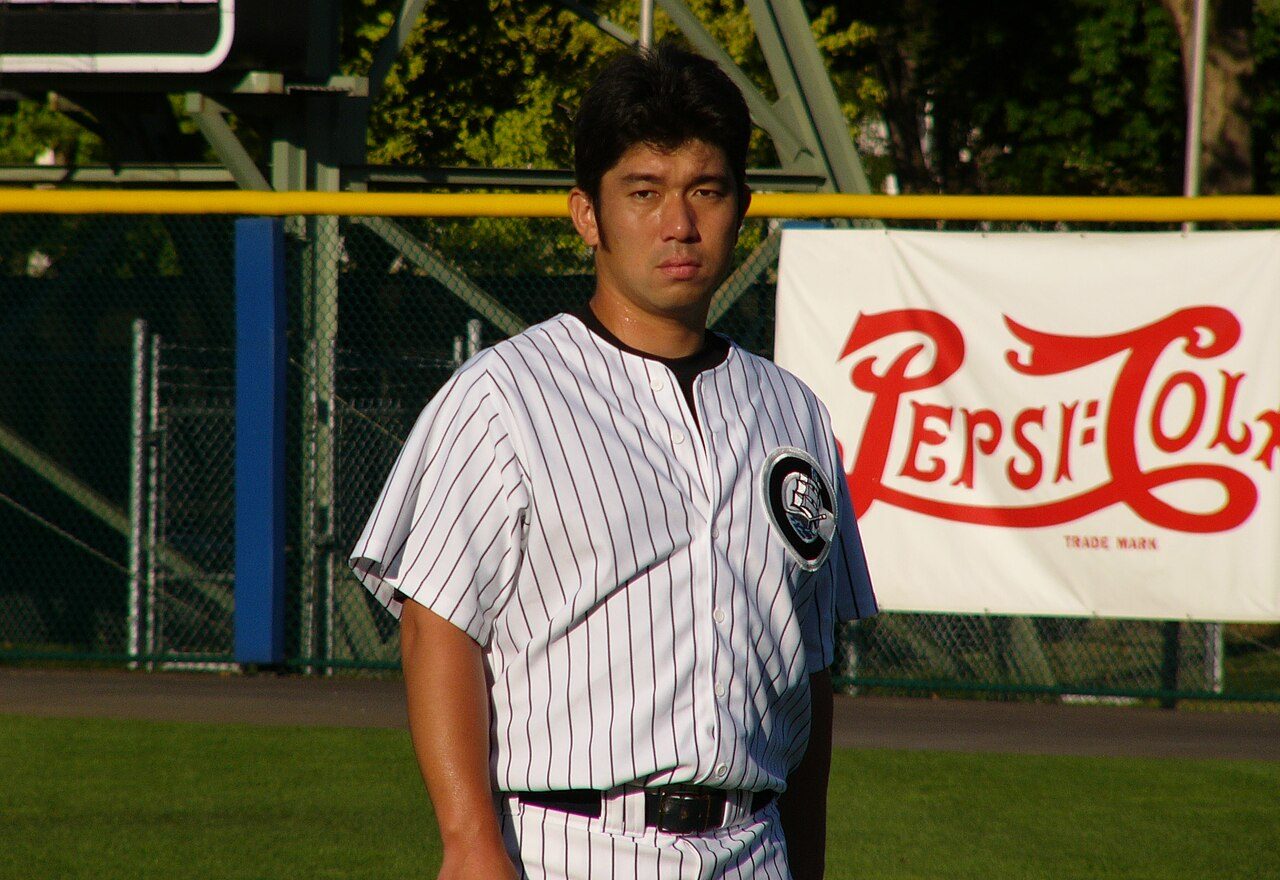
Photo: Ryosuke Yagi, CC BY 2.0, via Wikimedia Commons