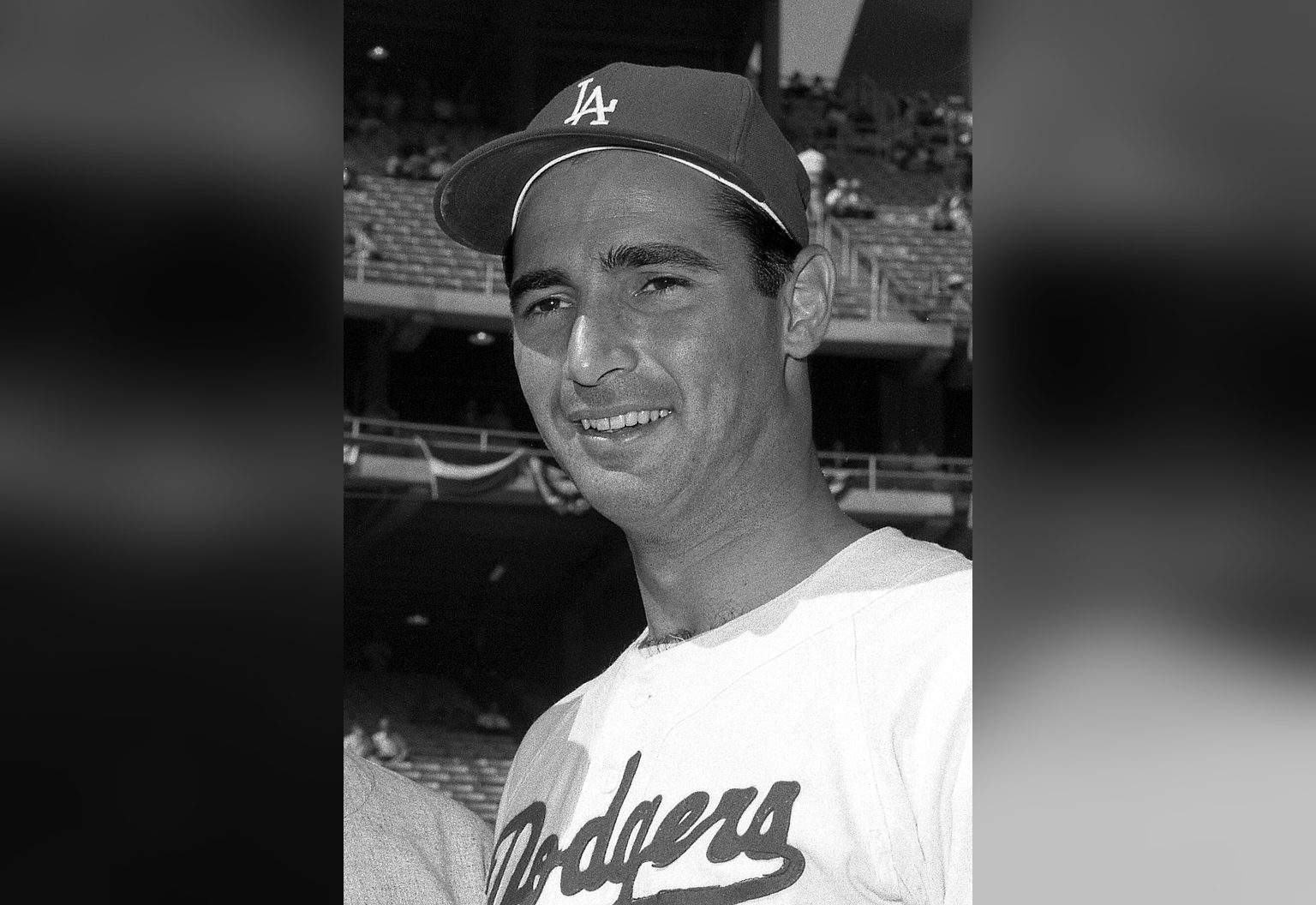
Four no-hitters. Three Cy Young Awards. A Hall of Fame plaque earned after only 12 major-league seasons. Sandy Koufax packed an extraordinary amount into a career that did not fully bloom until his mid-20s and ended before most pitchers are done with their prime.
From Brooklyn kid to raw pitching prospect
Sanford Braun was born on December 30, 1935, in Brooklyn, New York. After his parents divorced, his mother Evelyn later married Irving Koufax, and Sandy took his stepfather’s surname. He grew up in a city full of baseball, but for a long time he looked more like a basketball player than a future ace.
At Lafayette High School in Brooklyn, he stood out on the court and served as basketball captain. Baseball came later and less conventionally. He was not one of those prodigies groomed on the mound from childhood. In fact, he played first base as a senior before his pitching arm began to draw serious attention. That late start helps explain the shape of the Sandy Koufax story: immense talent, uneven beginnings, then a peak that burned very bright.
Basketball helped carry him to the University of Cincinnati on a scholarship. There, in limited college action, he showed the kind of arm scouts could not ignore. He was still raw, still learning mechanics and command, but the fastball was already special. During his rookie season in pro ball, he also studied at Columbia University’s School of General Studies, an unusual detail for a young player trying to survive in the majors.
Signed by Brooklyn, rushed straight to the majors
On December 14, 1954, the Brooklyn Dodgers signed Koufax for a $20,000 bonus contract that included a $6,000 salary and a $14,000 signing bonus. Under baseball’s bonus rule, that meant he had to stay on the major-league roster rather than develop in the minors.
That mattered. Many gifted pitchers get their wildness out of the way in smaller parks and smaller games. Koufax had to do it in public, against big-league hitters, on a contending club. The early years were full of flashes and frustration.
He debuted with Brooklyn in 1955, the same year the Dodgers won their first World Series title. Koufax was part of that team, though not yet one of its central figures. He pitched for Brooklyn through 1957, then moved with the franchise to Los Angeles in 1958. Through those first seasons, the ingredients were obvious: a lively fastball, a hard overhand curve, and command that came and went.
The long apprenticeship before the breakthrough
For a while, Koufax looked like a classic case of promise without polish. He led the National League in walks in 1958 and again in 1960. There were stretches when the Dodgers could see the arm but not yet trust the results.
Then the career turned.
In 1961, he struck out 269 batters and made the first of his All-Star teams in that breakthrough period. From there, the game changed for him. Better mechanics, better command, and full trust in his stuff turned him from an intriguing left-hander into the most feared pitcher in baseball.
From 1962 through 1966, he led the National League in ERA every season. He led the majors in strikeouts four times: 1961, 1963, 1965 and 1966. He won the pitching Triple Crown three times, in 1963, 1965 and 1966.
Those are the headline numbers, but the feel of it matters too. Hitters were not just losing to him. They were often overmatched.
The Dodgers ace at full force
Koufax finished his career with a 165-87 record, a 2.76 ERA, 2,396 strikeouts, 40 shutouts and nine saves. Those totals are impressive on their own, but they land differently once you remember how short his career was and how ordinary his early seasons looked.
His best run came in compressed form. Between 1962 and 1966, he won three Cy Young Awards and the 1963 National League MVP. At the time, there was only one Cy Young Award for both leagues, which makes those wins stand out even more. He remains the only pitcher to win three Cy Youngs under that one-award format.
In 1963, he went 25-5 with a 1.88 ERA and 306 strikeouts. In 1965, he followed with a 26-8 record, a 2.04 ERA and 382 strikeouts, then a National League record. In 1966, despite pitching through serious elbow pain, he went 27-9 with a 1.73 ERA and 317 strikeouts.
That last figure says plenty about his toughness. So does the fact that he kept dominating while his elbow was steadily giving out.
Four no-hitters, one perfect night
Some pitchers build their reputations over seasons. Koufax did that, but he also left behind a string of singular games that still sit near the top of baseball history.
He threw four no-hitters, in 1962, 1963, 1964 and 1965. At the time, that was a major league record. The fourth, on September 9, 1965, was a perfect game against the Chicago Cubs. He struck out 14 that night, and the game became the cleanest snapshot of what he was at his peak: overpowering, precise, almost unreachable.
His no-hit run was not a novelty. It matched the broader pattern of his best years, when shutouts, strikeouts and complete control of a game became routine enough to seem normal.
October, Yom Kippur and a World Series record
The Dodgers won four World Series titles during Koufax’s time with the club: 1955, 1959, 1963 and 1965. He was not yet the star in 1955, and he did not pitch in the 1959 World Series, but by the mid-1960s he had become the center of the Dodgers’ October hopes.
In the 1963 World Series against the Yankees, he went 2-0 with a 1.50 ERA and struck out 23 in 18 innings. In Game 1, he set a World Series record with 15 strikeouts in a nine-inning game. He was named World Series MVP.
Two years later came the most discussed decision of his career. Game 1 of the 1965 World Series fell on Yom Kippur, and Koufax did not pitch. He sat out in observance of the Jewish holy day, a choice that became one of the most remembered intersections of sports and faith in American baseball.
When he did take the mound in that series against Minnesota, he was brilliant. He finished 2-1 with a 0.38 ERA, threw complete-game victories in Games 5 and 7 on short rest, and won his second World Series MVP award. Across his World Series career, he posted a 0.95 ERA in 57 innings.
The holdout, the pain and the early ending
Before the 1966 season, Koufax and fellow Dodgers star Don Drysdale staged a well-known joint holdout as both sought better contracts. The two pitchers even appeared together on television during the dispute, signaling a rare show of player leverage for that era. Koufax eventually signed for $125,000; Drysdale received $110,000.
The contract story was notable, but the larger issue was physical. Koufax had been pitching through chronic traumatic arthritis in his left elbow. Treatments helped him take the mound, but only to a point. The pain was severe, and there was real concern about permanent damage to his arm.
On November 18, 1966, he retired at age 30.
That remains one of the defining facts of his career. He did not fade. He stopped while still at the top, because his body would not let him continue.
Hall of Fame and place in baseball history
In 1972, Koufax was elected to the Baseball Hall of Fame. At 36, he became the youngest player elected at that time. His career totals were lower than many Hall of Fame pitchers simply because he had fewer seasons, but his peak was so dominant that the case was never really about accumulation.
He was later named to Major League Baseball’s All-Century Team and the MLB All-Time Team, honors that reflect how strongly his best years still resonate.
For the Brooklyn Dodgers and Los Angeles Dodgers alike, he remains one of the franchise’s defining figures: the late-blooming left-hander who turned raw ability into one of the sport’s most concentrated runs of excellence.
What made Sandy Koufax so hard to hit
Koufax threw left-handed and batted right-handed. He was listed at 6-foot-2 and 210 pounds, but the frame only tells part of the story. What separated him was the life on the fastball and the shape of the curveball, delivered from a high arm slot that made both pitches play bigger.
When his command arrived, hitters had to deal with velocity, angle and late break all at once. That is why his strikeout totals jumped so dramatically and why his best seasons were full of shutouts and low ERAs rather than just narrow escapes.
The nickname “The Left Arm of God” has followed him for decades. It is colorful, but the numbers underneath it are real enough: four no-hitters, three Cy Young Awards, an MVP, two World Series MVPs and one of the sharpest five-year peaks any pitcher has produced.
Life away from the mound
Off the field, Koufax has generally kept a private profile. He married Anne Widmark on January 1, 1969; the marriage later ended in divorce. He has long been associated with Vero Beach, Florida, where the Dodgers once held spring training.
Soon after retiring, he moved into broadcasting. In December 1966, he signed a 10-year contract with NBC reportedly worth $1 million, though he left that role after six years. According to SABR, he never seemed fully comfortable in the job, which fits the broader picture of a star who was rarely eager to live loudly in public.
His connection to the Dodgers continued in later years. He served as a part-time pitching instructor from 1979 to 1990 and later worked as a special adviser to the club.
There are a few other off-field details that have surfaced in published accounts. According to SABR, Koufax was among the investors affected by Bernie Madoff’s fraud, and he reportedly suffered financial losses. Claims about Sandy Koufax net worth vary widely online and are often unsourced, so they are better treated cautiously than repeated as firm fact.
As for personal rumors, one long-circulating story about his private life has been described in secondary accounts as false or unsubstantiated. There is no good reason to present rumor as biography, and Koufax himself has spent most of his post-playing life avoiding exactly that kind of public noise.
FAQ
Why did Sandy Koufax retire so young?
He retired at 30 because of chronic traumatic arthritis in his pitching elbow and concern about permanent damage.
How many no-hitters did Sandy Koufax throw?
He threw four no-hitters, including a perfect game on September 9, 1965.
Did Sandy Koufax ever play in the minor leagues?
No. Because of baseball’s bonus rule when he signed with Brooklyn, he stayed on the major-league roster.
What was Sandy Koufax’s jersey number?
He is most closely associated with No. 32 for the Dodgers.
How many World Series titles did Sandy Koufax win?
He was on four Dodgers championship teams: 1955, 1959, 1963 and 1965.
Did Sandy Koufax sit out a World Series game for Yom Kippur?
Yes. He did not pitch Game 1 of the 1965 World Series because it fell on Yom Kippur.
Photo: Los Angeles Times, CC BY 4.0, via Wikimedia Commons