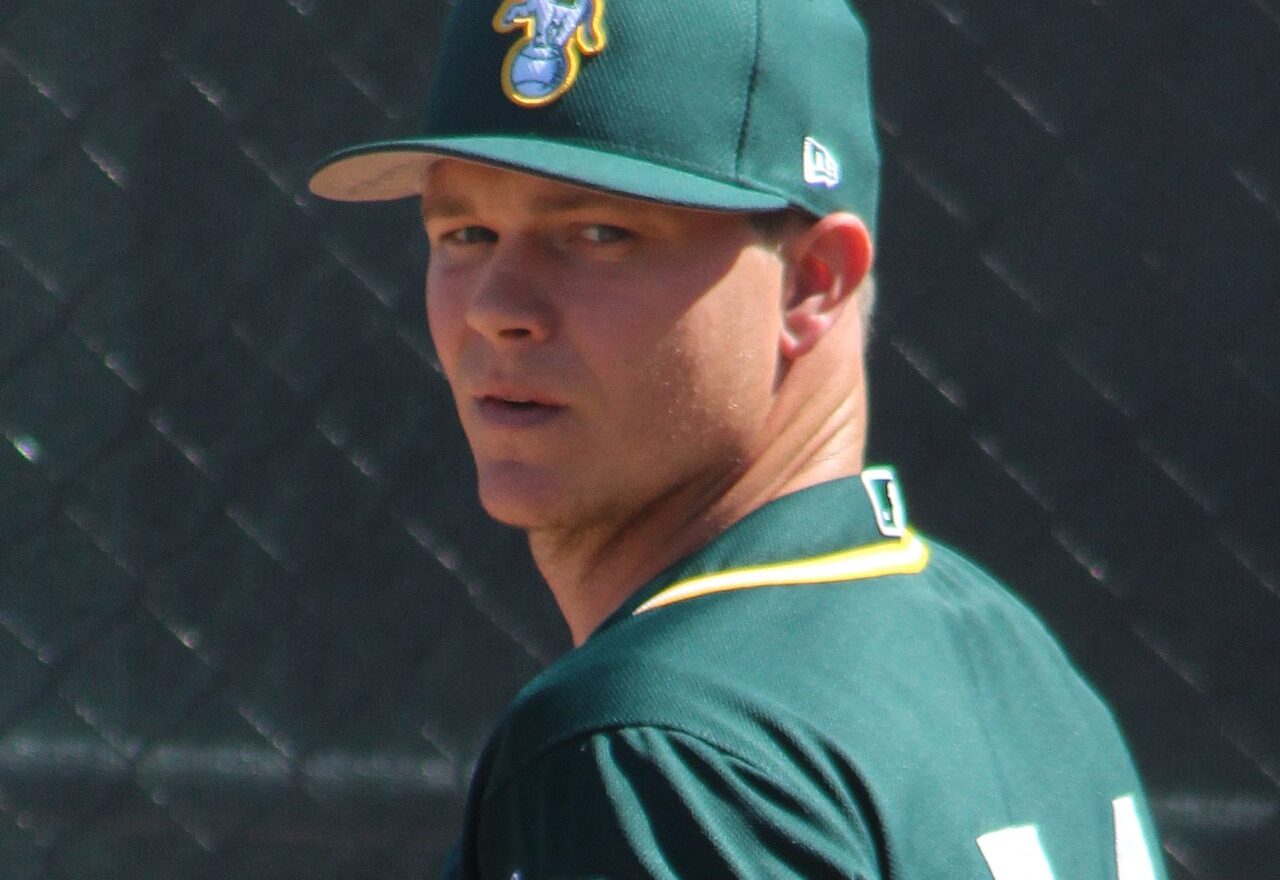
Eight scoreless innings against Detroit in the 2013 playoffs made Sonny Gray difficult to overlook. Making his first postseason start, the Oakland rookie matched Justin Verlander through a tense October night before the Athletics won 1-0 in the ninth.
He had reached the majors less than three months earlier. Already, Oakland trusted him with a game that could turn its season.
That combination of competitiveness and sharp breaking pitches carried the Tennessee right-hander through All-Star seasons with three organizations. His career has also included a difficult New York stint, a revival in Cincinnati and a Cy Young runner-up finish in Minnesota.
Smyrna: a quarterback with a baseball future
Born on November 7, 1989, in Smyrna, Tennessee, Sonny Douglas Gray grew up with two sporting calendars. Baseball occupied the warmer months; football put him under the Friday-night lights.
At Smyrna High School, he played quarterback and helped win Tennessee state championships in 2006 and 2007. Standing about 5-foot-10, he did not fit the towering physical template often associated with either quarterbacks or major league starters. His results mattered more.
His adolescence also brought a devastating loss. His father, Jesse, died in a car accident in 2004, when Gray was 14. Published accounts of his upbringing describe how his family and the Smyrna community supported him afterward.
The Chicago Cubs selected him in the 27th round of the 2008 draft, but he chose Vanderbilt rather than professional baseball. Staying in Tennessee gave him the chance to develop against Southeastern Conference hitters while remaining close to home.
By 2011, he was a central figure on the team that took Vanderbilt to its first College World Series. Oakland selected him 18th overall that June, giving his professional career a very different starting point from the late-round opportunity he had declined three years earlier.
Oakland puts its trust in the rookie
Gray moved through Oakland’s system quickly, with stops at Double-A Midland and Triple-A Sacramento. His major league debut came on July 10, 2013, in relief against Pittsburgh.
By August, he was starting. By October, he was facing Verlander in the American League Division Series.
His eight-inning performance in Game 2 included nine strikeouts and no runs allowed. Oakland returned to him for the deciding fifth game, which Detroit won. The series ended in disappointment, but the Athletics had found a starter they were willing to use in their biggest games.
His first full season confirmed that promise. In 2014, he went 14-10 with a 3.08 ERA and 183 strikeouts across 219 innings.
The awards breakthrough came the following year, not in 2014. Gray finished 2015 at 14-7 with a 2.73 ERA, earned his first All-Star selection and placed third in American League Cy Young voting. He also shared the league lead with two shutouts.
A strained right trapezius and a forearm injury interrupted his 2016 season, when his ERA rose to 5.69. He recovered enough in 2017 to become a prominent trade target, and Oakland moved him to the Yankees on July 31.
New York struggles, then a Cincinnati reset
The Yankees acquired Gray for prospects Dustin Fowler, Jorge Mateo and James Kaprielian, expecting him to strengthen a postseason rotation.
The fit never became comfortable.
Across the remainder of 2017 and the 2018 season, he went 15-16 with a 4.51 ERA and 182 strikeouts for New York. His struggles at Yankee Stadium were particularly pronounced, and he lost his rotation place during 2018.
The Yankees traded him to Cincinnati on January 21, 2019. As part of the move, he agreed to a three-year, $30.5 million extension covering 2020-22, with a club option for 2023.
Cincinnati offered a useful reunion: pitching coach Derek Johnson had coached him at Vanderbilt. The results changed quickly.
Gray went 11-8 with a 2.87 ERA and 205 strikeouts in 2019, earning his second All-Star selection and finishing seventh in National League Cy Young voting. The strikeout total was a career high, achieved in 175⅓ innings.
He remained with the Reds through 2021. Injuries limited portions of that stretch, but the Cincinnati years restored his standing as an effective major league starter after the uncertainty in New York.
Minnesota brings his best Cy Young finish
Minnesota acquired Gray on March 13, 2022, sending pitching prospect Chase Petty to Cincinnati. In his first Twins season, he posted a 3.08 ERA over 24 starts.
His second was better.
In 2023, he finished 8-8, a record that concealed the quality of his work. Across 184 innings, he struck out 183 hitters and recorded a 2.79 ERA. He made his third All-Star team and finished second to Gerrit Cole in American League Cy Young voting.
Most striking was what opponents could not do: hit the ball out of the park. Gray surrendered only eight home runs, producing an MLB-leading rate of 0.39 per nine innings.
He also recorded his 1,500th career strikeout against Tampa Bay on September 11.
October brought a more tangible team achievement. Gray threw five scoreless innings against Toronto in Game 2 of the Wild Card Series, helping Minnesota complete a sweep and win its first postseason series since 2002.
St. Louis: strikeouts and an 89-pitch shutout
The Cardinals signed Gray to a three-year, $75 million contract in November 2023, covering the 2024-26 seasons. The agreement included a club option for 2027, not a mutual option.
A hamstring injury delayed his first regular-season appearance, but he delivered 203 strikeouts in 166⅓ innings during 2024. He finished 13-9 with a 3.84 ERA.
Those numbers captured both sides of the season. He missed bats at an exceptional rate (nearly 11 strikeouts per nine innings) but allowed considerably more home runs than he had in Minnesota.
In 2025, he went 14-8 with a 4.28 ERA and 201 strikeouts, giving him consecutive 200-strikeout seasons.
His sharpest outing came against Cleveland on June 27: a one-hit shutout with 11 strikeouts, completed on just 89 pitches. A complete-game shutout in fewer than 100 pitches is commonly called a “Maddux,” after Greg Maddux.
For a pitcher capable of working deep counts in pursuit of strikeouts, it was an unusually economical afternoon. Cleveland scarcely reached base, and Gray never needed a hundredth pitch.
How Sonny Gray attacks hitters
Gray’s effectiveness comes from movement, changing speeds and giving hitters several pitches to consider.
His curveball has long been a central weapon. He also uses sliders and sweepers, along with different fastball shapes, to change the direction of an at-bat. The repertoire has evolved rather than remaining fixed from his Oakland days.
At his best, he can get a ground ball when he needs one or finish a hitter with a breaking pitch below the zone. His compact frame does not prevent him from generating sharp movement.
There are limits to the statistical shorthand, though. Home-run prevention has not been equally strong every season, and his command has sometimes wavered. The remarkable Minnesota season and the higher home-run totals that followed in St. Louis belong to the same pitcher’s story.
Family ties beyond the ballpark
Gray married Jessica Forkum in November 2016. Public profiles have described the family’s ties to the Nashville area, keeping Tennessee central to his life despite the movement of a major league career.
His football background remains a distinctive part of that story. Before opposing hitters were trying to identify his breaking ball, high school defenses were trying to stop him at quarterback.
There is also the nickname: “Pickles,” which has appeared on his Players’ Weekend jersey. It offers a lighter counterpoint to the concentrated, sometimes visibly frustrated competitor seen on the mound.
The personal details that are publicly established (his Tennessee roots, Vanderbilt years and family connections) help explain why home has remained a recurring thread through so many changes of uniform.
FAQ
Where is Sonny Gray from?
He was born in Smyrna, Tennessee, and attended Smyrna High School before pitching at Vanderbilt University in Nashville.
When was Sonny Gray drafted?
The Cubs selected him in the 27th round in 2008, but he chose college. Oakland drafted him 18th overall in 2011.
Which MLB teams has he pitched for?
Through the 2026 season, he had appeared for the Athletics, Yankees, Reds, Twins, Cardinals and Red Sox.
Has he won a Cy Young Award?
Through 2025, he had not won the award. His highest finish was second in the 2023 American League voting with Minnesota.
How many All-Star selections does he have?
He earned three selections through 2025: with Oakland in 2015, Cincinnati in 2019 and Minnesota in 2023.
Who is Sonny Gray’s wife?
He is married to Jessica Gray, formerly Jessica Forkum. They married in November 2016.
Photo: jnashboulden, CC BY-SA 2.0, via Wikimedia Commons