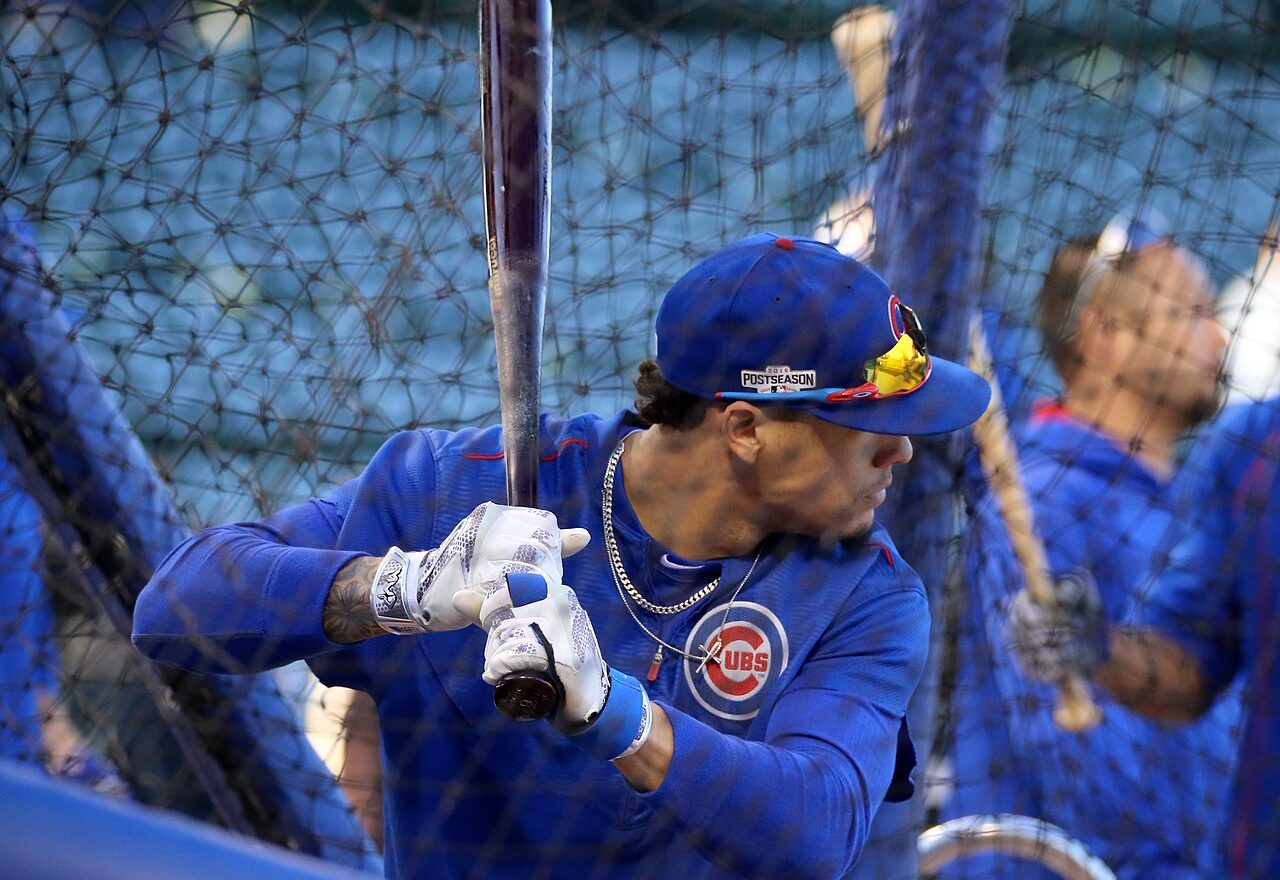
In the 12th inning of his first major-league game, Javier Báez hit a home run that won it for the Cubs. The August 5, 2014, swing in Colorado offered an early glimpse of a player who could change a game abruptly-and who rarely seemed interested in taking the cautious route.
Chicago would come to know the rest: the sweeping tags, the daring slides, the power and the swings at pitches he had little chance of reaching. Nicknamed “El Mago,” or “the Magician,” Báez became a World Series champion before moving through New York to Detroit, where a major contract brought a different set of expectations.
From Bayamón to Jacksonville
Ednel Javier Báez was born on December 1, 1992, in Bayamón, Puerto Rico. His father, Ángel Luis, encouraged his interest in baseball but died when Javier was 10.
In 2005, the family moved to Jacksonville, Florida, seeking medical care for his younger sister, Noely, who had spina bifida. The relocation meant adjusting to a new school system and learning English while baseball provided something familiar.
At Arlington Country Day School, Báez played around the diamond, including shortstop, second base, center field and catcher. His hands and arm attracted attention, but so did the force of his swing. He committed to Jacksonville University before the Cubs selected him ninth overall in the 2011 MLB Draft.
He chose professional baseball. Chicago was rebuilding, and the teenager became one of the prospects around whom the organization’s next competitive team would take shape.
Power carries him toward Wrigley Field
Báez began his professional career with the rookie-level Arizona Cubs and Boise Hawks in 2011. He advanced through Peoria and Daytona the following season, then made a much louder impression in 2013.
Across Daytona and Double-A Tennessee, he hit 37 home runs and drove in 111 runs. The production made his appeal obvious: this was an infielder with middle-of-the-order power. His aggressive approach also brought strikeouts, a trade-off that would follow him into the majors.
After opening 2014 with Triple-A Iowa, he received his first call-up in August. His debut home run against the Rockies made him the first player since Miguel Cabrera in 2003 to homer in extra innings in his first MLB game.
Two more home runs followed in his third appearance. He became the first player since Joe Cunningham in 1954 to hit three homers in his first three major-league games.
The adjustment was not seamless. Pitchers found ways to exploit his willingness to chase, and he returned to Iowa in 2015. His sister’s death that April added a personal loss to an already demanding period.
October gives “El Mago” a bigger stage
By 2016, Báez had become an important part of a Cubs roster built to win. Manager Joe Maddon could move him among infield positions, finding room for his defense even when the lineup was crowded.
His tags became a particular attraction. Rather than simply waiting with the glove, he anticipated the runner’s route and brought the ball down quickly, sometimes finishing the play before the runner appeared to recognize the danger.
That October, the bat and legs mattered too. His ninth-inning single completed Chicago’s comeback against San Francisco in Game 4 of the National League Division Series, sending the Cubs into the next round.
In the NL Championship Series opener against the Dodgers, he stole home-the first Cub to do so in postseason play since 1907. He shared NLCS MVP honors with pitcher Jon Lester as Chicago reached its first World Series since 1945.
The Cubs then defeated Cleveland in seven games to win the 2016 championship, ending a 108-year title drought. Báez was 23.
An All-Star peak, with an aggressive edge
The championship established his place in Chicago. The 2018 season showed how much offense he could supply.
Báez hit .290 with 34 home runs, 21 stolen bases and a National League-leading 111 RBIs. He made his first All-Star team, won the Silver Slugger Award at second base and finished second to Christian Yelich in NL MVP voting.
He returned to the All-Star Game in 2019. Even at his best, however, his approach offered little margin for restraint: he could punish a mistake, then chase a breaking ball far outside the strike zone.
His defense remained valuable across positions. He collected four Fielding Bible Awards between 2016 and 2020 and won the National League Gold Glove at shortstop in 2020.
Báez also brought that style to Puerto Rico’s national team. He helped the island reach the 2017 World Baseball Classic final and earned All-WBC Team selections in both 2017 and 2023.
A brief, eventful stop with the Mets
On July 30, 2021, Chicago traded Báez and pitcher Trevor Williams to the New York Mets for outfield prospect Pete Crow-Armstrong. The deal came amid the breakup of the Cubs’ championship core.
In New York, Báez joined fellow Puerto Rican infielder Francisco Lindor. Over 47 games, he hit .299 with nine home runs and 22 RBIs, providing productive offense during a disappointing finish for the Mets.
His stay also included a public dispute with fans. Báez explained that a thumbs-down celebration used by some players was a response to booing. He and Lindor subsequently apologized.
The numbers were strong; the relationship with the crowd was more complicated. After the season, Báez entered free agency.
Detroit brings a long commitment-and difficult seasons
The Tigers signed Báez to a six-year, $140 million contract on December 1, 2021. Detroit wanted an established shortstop to help move its rebuild forward.
His first game delivered a fitting introduction: a walk-off single against the White Sox on April 8, 2022. Sustained production proved harder to find. He finished that season batting .238 with 17 home runs and 77 RBIs.
In 2023, his average fell to .222, with nine homers and 59 RBIs. That April, manager A. J. Hinch removed him from a game after a sequence in which Báez failed to run hard out of the batter’s box and later lost track of the number of outs.
The difficulties continued in 2024. He hit .184 with six home runs and 37 RBIs in 80 games before a hip injury ended his season and required surgery.
A rebound followed in 2025: a .257 average, 12 home runs and 57 RBIs. With Detroit using him in center field as well as the infield, he earned his third All-Star selection and his first since 2019.
Family, tattoos and life away from the diamond
Family has been central to Báez’s story since the move from Puerto Rico. His sister’s medical needs-not a baseball opportunity-brought the family to Florida, and her death came just as he was trying to establish himself professionally.
He and his brothers have matching MLB-logo tattoos, a visible reminder of their shared attachment to the game.
Báez is married to Irmarie Márquez, and the couple have two sons. There is another major-league connection in the extended family: Márquez’s sister is married to pitcher José Berríos, making the two players brothers-in-law.
His visibility has also reached beyond the ballpark. He appeared on the cover of MLB The Show 20, with the game drawing on the same expressive style that made him recognizable in Chicago.
That style has never been entirely tidy. The ambitious swing, the risky advance and the improvised defensive play belong to the same player. At his best, Báez made those choices pay off in ways few teammates could duplicate; during his struggles, the costs were just as visible.
FAQ
Where is Javier Báez from?
He was born in Bayamón, Puerto Rico, and moved with his family to Jacksonville, Florida, in 2005.
What does “El Mago” mean?
It means “the Magician” in Spanish, a nickname associated with his inventive defense and quick tags.
Which MLB teams has he played for?
He has played for the Chicago Cubs, New York Mets and Detroit Tigers. He joined Detroit ahead of the 2022 season.
What positions does he play?
He has primarily played shortstop and second base, with additional experience at third base and in center field. His catching experience dates to his school years, not a regular MLB role.
Did Javier Báez win a World Series?
Yes. He won the 2016 World Series with the Cubs and shared that postseason’s NLCS MVP award with Jon Lester.
How many All-Star selections has he earned?
Through the 2025 season, he had three: in 2018 and 2019 with Chicago, and in 2025 with Detroit.
Photo: Arturo Pardavila III from Hoboken, NJ, USA, CC BY 2.0, via Wikimedia Commons