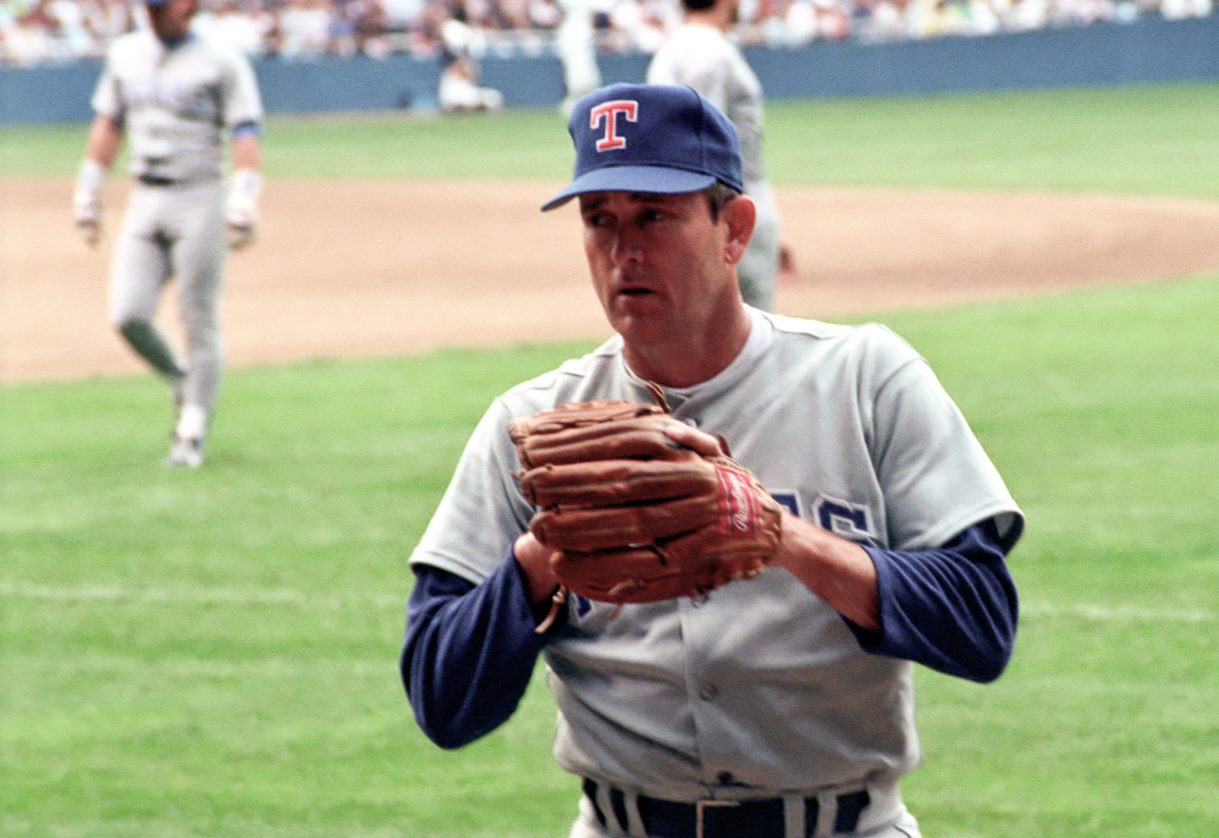
Seven no-hitters would be enough for most careers. Nolan Ryan paired them with 5,714 strikeouts, a fastball that became part of baseball folklore, and a run in the majors so long that it began in the 1960s and ended in the 1990s. By the time he walked away, the right-hander known as “The Ryan Express” had pitched for the Mets, Angels, Astros, and Rangers and built one of the strangest, most enduring statistical records the sport has seen.
From South Texas to the Mets system
Lynn Nolan Ryan Jr. was born on January 31, 1947, in Refugio, Texas, and grew up in Alvin, where baseball quickly became the center of his athletic life. He was the youngest of six children, and the Texas roots that shaped his early years stayed with him long after his playing career ended.
At Alvin High School, his arm stood out early. The New York Mets drafted him in the 12th round in 1965, 226th overall, and he signed instead of going to college. His climb through the minors moved quickly: Marion, Greenville, Williamsport, Winter Haven, then Jacksonville. The raw material was obvious. Ryan threw harder than almost anyone, missed bats in bunches, and just as often fought his command.
That combination never really left him. It was there when he was a teenager in the Mets system, and it was still there when he retired nearly three decades later.
A young arm on a championship Mets club
Ryan first reached the majors in 1966, though his early New York years were interrupted by military service and time back in the minors. He returned for good in 1968 and became part of the club that would soon turn into the “Miracle Mets.”
He was not yet the finished version of the pitcher baseball would later know, but the ingredients were easy to spot: premium velocity, a hard-breaking curveball, and innings that could swing from unhittable to chaotic. In 1969, he contributed to New York’s championship season and had one of his first big October moments in the National League Championship Series against Atlanta, working 2 1/3 scoreless relief innings in Game 3 to help close out the series. The Mets went on to win the World Series, giving Ryan his first and only championship ring as a player.
His New York numbers did not yet hint at the full scale of the Nolan Ryan career. They did, however, introduce the pattern that would define it. Hitters struggled to make clean contact. Catchers and managers had to live with the walks.
After the 1971 season, the Mets traded him to the California Angels for shortstop Jim Fregosi, a deal that has lived for decades as one of the more lopsided trades of its era.
California Angels and the full arrival of Nolan Ryan
In Anaheim, the power arm turned into a headline act.
Ryan joined the Angels in 1972, and almost immediately the strikeout totals exploded. In his first season there, he made the All-Star team, led the American League with 329 strikeouts, and began a run in which he would lead his league in strikeouts year after year. He did it again in 1973, 1974, 1976, 1977, 1978, and 1979.
The most famous number from that stretch came in 1973, when he struck out 383 hitters, still the modern major league record for a single season. He also threw two no-hitters that year. The Angels had acquired a pitcher with electric stuff; what they got was a force who could dominate a game even when his control wandered.
That tension is central to understanding his greatness. Ryan was never a tidy, low-pitch-count craftsman. He was a storm. He led the league in walks more than once and finished with a record 2,795 of them. But he also made hitters look overmatched in a way few pitchers ever have. Over his career, opponents hit just .204 against him, the lowest batting average allowed by any pitcher with at least 1,500 innings. His 6.56 hits allowed per nine innings is also the best mark in that group.
The nickname fit. “The Ryan Express” captured not only the speed of the fastball but the feeling of facing him. At his best, at-bats looked rushed. Swings came late. Contact, when it happened, was often weak.
By the end of the 1970s, he had become one of baseball’s defining pitchers, even without a Cy Young Award. The strikeouts, the no-hitters, the one-hitters, the sheer violence of the fastball, all of it had made him unmistakable.
Houston, big money, and another peak
A new chapter opened after the 1979 season, when Ryan signed with the Houston Astros. The contract was a four-year deal worth $4.5 million, making him baseball’s first player with an average annual salary above $1 million. That mattered at the time, not just as a business milestone but as a sign that elite pitching had entered a different financial tier.
He pitched for Houston from 1980 through 1988 and aged in a way that made little sense by normal standards. Most power pitchers lose something in their 30s. Ryan kept missing bats.
With the Astros, he went 106-94 with a 3.13 ERA and 1,866 strikeouts. He made the All-Star team in 1981 and 1985, led the National League in ERA in the strike-shortened 1981 season, and did it again in 1987 with a 2.76 mark. He also led the league in strikeouts in 1987 and 1988, deep into his 40s.
Houston gave him some quieter, more human details too. On April 12, 1980, he hit one of the two home runs of his career, a three-run shot off Don Sutton. He also became known for some old-school maintenance habits, including soaking his fingers in pickle brine to help deal with blisters. For a pitcher associated with radar-gun readings and historic strikeout totals, it was a fittingly practical detail.
The Astros years also brought another no-hitter, more All-Star recognition, and more proof that his career would not follow the usual aging curve.
A Texas finish that stretched the limits of longevity
Then came the Rangers, and with them the final act most pitchers never get to write.
Ryan signed with Texas before the 1989 season and stayed through 1993. He was already in his 40s, already a first-ballot Hall of Fame talent in waiting, and still capable of overpowering lineups. In his first season with the Rangers, he made another All-Star team. In 1990 and 1991, he threw his sixth and seventh no-hitters, extending a record that still stands.
His time in Arlington was about more than a few ceremonial late-career appearances. He remained effective, posting a 3.43 ERA with 939 strikeouts in 840 innings for the club. He also became a symbol of baseball durability, pitching across four different decades and retiring as the last active major leaguer from the 1960s.
One image from that period remains impossible to separate from his legend: the 1993 fight with Robin Ventura, when the 46-year-old pitcher put the younger White Sox infielder in a headlock after being charged on the mound. It was messy, brief, and unforgettable, a snapshot of Ryan’s competitiveness as much as his toughness.
His final season ended with injury. On September 22, 1993, he tore a ligament in his elbow while throwing a pitch against Seattle. It was the last pitch of his major league career.
The numbers that still tower over the game
Ryan retired with a 324-292 record, a 3.19 ERA, 5,714 strikeouts, 61 shutouts, 222 complete games, 3 saves, and a 1.247 WHIP. The strikeout total is the major league record by a wide margin. So are the seven no-hitters.
Some records explain his style as much as his dominance. He is the only pitcher to strike out more than 5,000 hitters. He had 15 seasons with at least 200 strikeouts and six with at least 300. He also finished with the most walks in major league history, which says plenty about the trade-off that came with all that power.
Other marks show how difficult he was to hit even when he was not perfectly in command. He threw 12 one-hitters, tied for the major league record, plus 18 two-hitters and 31 three-hitters. Few pitchers have ever lived so often on the edge between chaos and control and still produced this kind of damage.
He was an eight-time All-Star and entered the Hall of Fame in 1999 in his first year on the ballot. Multiple teams later retired his number, a rare honor that reflects how many franchises claim part of his story.
How he pitched
Ryan’s style was simple to describe and hard to survive. He attacked with a blazing four-seam fastball and a sharp curve, challenged hitters in the zone, and trusted that his stuff would win even if the command was not perfect.
There was intimidation in that approach, but it was not theater. It came from the reality of the at-bat. Hitters had to gear up for elite velocity, protect against the breaking ball, and accept that some pitches might not be especially close to hittable. He could be inefficient. He could run up pitch counts. He could walk too many men. Then he could strike out the side and erase the inning anyway.
That is why the Nolan Ryan stats can look almost contradictory at first glance: all-time strikeout king, all-time walk leader, and one of the hardest pitchers in history to hit. In his case, the contradictions are the point.
Life away from the mound
Texas remained the center of his life off the field too.
Ryan married his high school sweetheart, Ruth Holdorff, on June 26, 1967. They had three children: Reid, Reese, and Wendy. Unlike many celebrity-athlete profiles, the broad outline of his family life has long been public and consistent, with little need for rumor or tabloid framing.
After retiring, he built an unusually large business footprint. He became a rancher and businessman, with ventures that included Nolan Ryan Beef and banking interests in Texas. He also stayed close to baseball through ownership and executive roles, most notably with the Round Rock Express and later with the Texas Rangers’ front office.
His charitable work has been substantial as well. The Nolan Ryan Foundation has supported youth, education, and community causes in Texas. He and his family have also been linked to donations for medical and educational projects, including support for skin cancer research. Ryan has spoken publicly about surviving skin cancer, one of the more serious health challenges disclosed during his post-playing years.
He also served in the U.S. Army Reserve early in his professional career, another detail that belongs to the less-polished, more grounded version of his story.
FAQ
When was Nolan Ryan born?
Nolan Ryan was born on January 31, 1947.
How many strikeouts did Nolan Ryan have?
He finished with 5,714 career strikeouts, the most in major league history.
How many no-hitters did Nolan Ryan throw?
He threw seven no-hitters, also a major league record.
What teams did Nolan Ryan play for?
He played for the New York Mets, California Angels, Houston Astros, and Texas Rangers.
What was Nolan Ryan’s nickname?
His best-known nickname was “The Ryan Express.”
When did Nolan Ryan retire?
He retired in 1993 after an elbow injury ended his final season.
Photo: Chuck Andersen, CC BY 2.0, via Wikimedia Commons