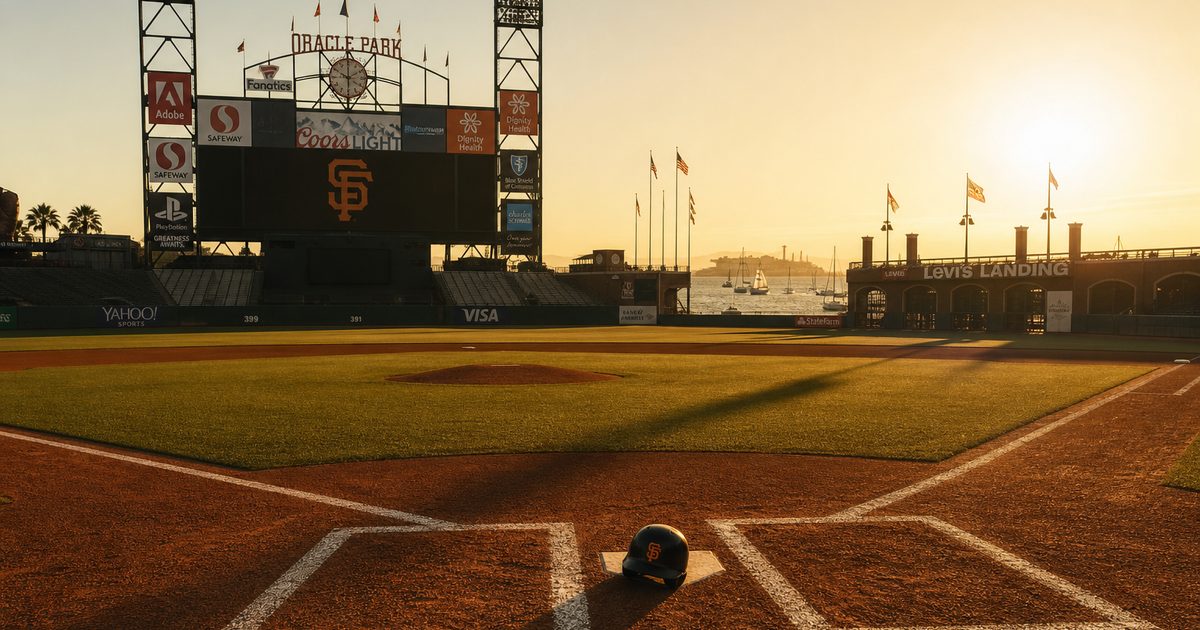
On August 7, 2007, Barry Bonds drove a pitch from Washington’s Mike Bacsik into the right-center-field seats at San Francisco’s AT&T Park. It was home run No. 756, the swing that moved him past Hank Aaron atop Major League Baseball’s career list. He finished with 762.
The record crowned a career that had begun with speed, defense and a famous baseball surname, long before pitchers started walking him rather than risking a strike. It also arrived under the shadow of the BALCO steroid investigation. Both belong in his story: the extraordinary production and the controversy that continues to shape how it is judged.
Growing up with Bobby Bonds and Willie Mays
Barry Lamar Bonds was born on July 24, 1964, in Riverside, California, to Bobby Bonds and Patricia Howard. His father was a major league outfielder whose combination of power and speed offered an early model for his son. Willie Mays was his godfather, and his aunt, Rosie Bonds, competed in hurdles at the 1964 Olympics.
That family background brought access to major league clubhouses, but also expectations. At Junípero Serra High School in San Mateo, Bonds played baseball, basketball and football. San Francisco selected him in the second round of the 1982 draft, but he chose Arizona State rather than signing.
Over three college seasons, the left-handed hitter batted .347 with 45 home runs and 175 RBIs. At the 1984 College World Series, he tied the tournament record with seven consecutive hits. Pittsburgh made him the sixth overall pick in the 1985 draft.
Pittsburgh: more than a home run hitter
His apprenticeship was brief. After stops with the Prince William Pirates and Hawaii Islanders, Bonds made his major league debut on May 30, 1986.
He was not yet the imposing slugger of his later San Francisco years. The young outfielder could run, cover ground and disrupt a game without hitting a ball over the fence. His rookie season included 16 home runs and 36 stolen bases, although a .223 batting average showed how much adjustment remained.
By 1990, those tools had come together. Bonds hit .301 with 33 home runs and 52 steals, helping Pittsburgh win the National League East. He collected his first MVP award, Gold Glove and Silver Slugger, alongside his first All-Star selection.
The Pirates won three consecutive division titles from 1990 through 1992 but never reached the World Series. Their final postseason defeat was particularly painful: Atlanta rallied in the ninth inning of Game 7 of the 1992 NL Championship Series, with former Pirate Sid Bream sliding home ahead of Bonds’ throw from left field.
Bonds won his second MVP that season. Then, after seven years, 176 home runs and 251 stolen bases with Pittsburgh, he left as a free agent.
San Francisco gets the player it once drafted
The Giants signed Bonds to a six-year, $43.75 million contract before the 1993 season. He wore No. 25, the number his father had worn in San Francisco.
He immediately gave the club its money’s worth: a .336 average, 46 home runs, 123 RBIs and another MVP award. The Giants won 103 games but finished one game behind Atlanta in the NL West. Under the postseason format then in place, their season ended without a playoff appearance.
Throughout the 1990s, his game remained broader than his home run totals suggested. He won eight Gold Gloves between 1990 and 1998, taking the award every year in that stretch except 1995. In 1996, he joined the 40-40 club with 42 homers and 40 steals.
His stance was compact, his hands quick and his judgment of the strike zone unusually sharp. Pitchers had to consider not just his power but whether he would chase their best attempt at avoiding it. Increasingly, he would not.
Seventy-three home runs, then a World Series
In 2001, Bonds hit 73 home runs, breaking the single-season record of 70 set by Mark McGwire in 1998. He also drew 177 walks and posted an .863 slugging percentage, another major league record.
That season began a run of four consecutive NL MVP awards. By its end in 2004, he had seven-more than any other player.
The team breakthrough came in 2002. Bonds won his first batting title with a .370 average, and San Francisco reached the World Series against the Anaheim Angels. After years of scrutiny over his earlier postseason performances, he hit .471 with four home runs in the seven-game Series. The Angels walked him 13 times.
Still, he finished without a championship. The Giants lost Game 6 after leading 5-0 and then lost Game 7.
Opposing managers became even less willing to challenge him. In 2004, Bonds hit .362 for his second batting title while setting single-season records with 232 walks, 120 intentional walks and a .609 on-base percentage. For long stretches, a plate appearance against him became a calculation about whether pitching to the next hitter was safer.
BALCO and the final pursuit of Aaron
As the records accumulated, the BALCO investigation changed the context around them. The Bay Area laboratory was at the center of a federal investigation into the distribution of performance-enhancing drugs.
According to published accounts of his 2003 grand jury testimony, Bonds acknowledged using substances supplied by trainer Greg Anderson but said he believed they were flaxseed oil and an arthritis balm, not steroids. He denied knowingly using performance-enhancing drugs.
The legal distinctions matter. Indicted in November 2007 on perjury and obstruction-of-justice charges, he was convicted of obstruction in 2011; the jury did not reach verdicts on the perjury counts tried. A federal appeals court overturned the obstruction conviction in 2015, and prosecutors subsequently dropped the remaining charges. No conviction from that prosecution remained.
Meanwhile, knee problems limited him to 14 games in 2005. He returned to pass Babe Ruth’s 714 career home runs in 2006 and Aaron’s 755 in 2007. That final season, he still produced a .480 on-base percentage and 28 home runs.
The Giants did not bring him back. He never played another major league game, although describing his departure as a conventional retirement misses the fact that he wanted to continue playing.
What the numbers reveal
Across 22 seasons, Bonds finished with a .298 average, 2,935 hits, 762 home runs and 1,996 RBIs. He earned 14 All-Star selections and 12 Silver Slugger awards.
His 514 stolen bases distinguish him from other career home run leaders. He remains the only major leaguer with both 500 homers and 500 steals-and the only player to reach 400 in each category.
Then there are the walks: 2,558 overall, including 688 intentional passes, both career records. They reflect two forces working together: his willingness to leave a pitch alone and opponents’ reluctance to give him something worth swinging at.
The later power numbers can obscure the earlier player. Pittsburgh’s lean, fast left fielder and San Francisco’s heavily walked slugger were different versions of the same unusually complete hitter.
Family, cycling and baseball after playing
Bonds has three children: Nikolai and Shikari from his marriage to Susann “Sun” Branco, and a daughter from his marriage to Liz Watson. Both marriages ended in divorce.
His relationship with reporters could be combative, but that public image was not the whole of his life away from the field. His charitable work has included the Bonds Family Foundation, established in 1993, and support for youth and education programs.
After his playing career, cycling became a prominent interest. The former power hitter took up long road rides, a different kind of athletic routine from preparing for a summer of major league games.
He also returned to baseball work. Bonds served as the Miami Marlins’ hitting coach in 2016 and became a special adviser to the Giants in 2017.
San Francisco retired his No. 25 on August 11, 2018. Pittsburgh inducted him into its team Hall of Fame in 2024. Those ceremonies recognized his place in both franchises; election to the National Baseball Hall of Fame has remained separate and elusive.
FAQ
How many home runs did Barry Bonds hit?
He hit an MLB-record 762 career home runs. His 73 in 2001 also remain the single-season record.
Which teams did he play for?
He played for the Pittsburgh Pirates from 1986 through 1992 and the San Francisco Giants from 1993 through 2007.
How many MVP awards did he win?
He won a record seven National League MVP awards: 1990, 1992, 1993 and four straight from 2001 through 2004.
Did he win a World Series?
No. His only World Series appearance came in 2002, when the Giants lost to the Anaheim Angels in seven games.
Is Barry Bonds in the Hall of Fame?
He is not in the National Baseball Hall of Fame. He is a member of the Pittsburgh Pirates Hall of Fame, which inducted him in 2024.
Was his obstruction conviction overturned?
Yes. A federal appeals court overturned his 2011 obstruction-of-justice conviction in 2015. Prosecutors later dropped the remaining charges.